he All-Star Game was a week away when the shocking news broke.
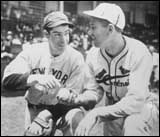 Joe DiMaggio, left, with Cardinals pitcher Dizzy Dean before the 1936 All-Star Game.
|
Scalpers were afoot. Yes, indeed. Someone operating out of a flower shop near the Boston Common had sold an All-Star Game ticket for - grab onto the nearest railing - $4. How scandalous! That was more than 300 percent above the face values of reserved tickets.
Ah, but scalpers beware. Boston Braves management was saying, ''We know who you are.''
According to the Globe's Melville E. Webb Jr., ''Up at the Beehive there is a record of every ticket issued. To whom, and the address to which tickets have been sent - and the location.''
Plus ca change, etc. The year was 1936.
Often forgotten is that the first baseball All-Star Game staged in Boston took place not at Fenway Park but at the larger National League Field, or Beehive, or, as it would soon be known, Braves Field. The game was notable for many reasons. It was the first National League victory in the four-year-old competition, it was stained by the strange sight of 17,000 empty seats, it was highlighted by some sensational pitching by the inimitable Dizzy Dean, and it represented perhaps the only time Joe DiMaggio was ever humiliated on the ball field.
Believers in omens had a funny feeling about this game before it ever started. For a huge story on the morning of the game concerned the fact that American League All-Stars Goose Goslin, Schoolboy Rowe, and Rollie Hemsley and umpire Bill Summers (one of three Bay State natives working the game) had been involved in a train wreck southwest of Cleveland while traveling from St. Louis. The men were unhurt, but they did arrive in Boston accompanied by a buzz.
The empty seats came about due to a regrettable, if earnest, decision by Braves management to treat the game as any other in fairness to the average fan. The reserve seat sale was restricted to 17,000. The remaining 25,000 ''rush'' seats would be placed on sale the morning of the game. Communication was poor. Falsely believing the game was sold out, many thousands of interested people stayed away.
What they missed was a game described by no less an authority than Grantland Rice as ''the most entertaining and feature-studded of all to date.''
The National League won, 4-3, building a 4-0 lead after five and then holding on when the Americans scored three in the seventh off Curt Davis and threatened for more, only to have the rally squelched when DiMaggio, in the midst of a classically frustrating day, saw his sizzling line drive caught by Leo Durocher to end the inning.
The game included a somewhat controversial solo homer by National League center fielder Augie Galan, whose wrong-field shot in the fifth hit the foul pole (in those days the league ground rules differed; in the American League it would have been a foul ball because it landed foul), and a mammoth solo clout by the American's Lou Gehrig to lead off the seventh.
The Iron Horse was, to that point, an All-Star flop. En route to the game, Gehrig had said, ''I've got the worst All-Star record in the game, and I'm going to do something about it.'' A 430-foot homer made him feel better.
The unquestioned pitching star was NL starter Dean, then 25 years of age and enjoying what would prove to be his last great season (an injury in the '37 game would wreck his career). Ol' Diz was in superb form on this day, working three scoreless innings marred only by a pair of walks. Otherwise ...
''They couldn't hit him at two paces with a handful of shot,'' declared Rice, who added, ''Diz had more smoke than a burning oil well and he handled the crack sluggers of the American League as if they had been members of a kindergarten school with camp colic.''
Dizzy crabbed about the two walks and his one time at bat (a whiff), but he couldn't deny he had his good stuff. ''The old fog ball goes in any league,'' he smirked. As a bonus, he even picked Gehrig off first base in the second.
DiMaggio represented the flip side of the equation. The rookie right fielder came into the game as young royalty (batting third, no less) and left it a humbled young man.
He was 0 for 5 - the only man with five official at-bats - and he three times made the final out of the inning. He had a man on each time and advanced not one. He hit into a first-inning double play. He had a comebacker to Carl Hubbell. In the field, things were even worse. He misplayed a second-inning Gabby Hartnett liner into a triple. He fumbled a Billy Herman single for an error that allowed Herman to advance to second.
When he did sting the ball, shortstop Durocher caught it to end the seventh with two aboard. A foot or two either way and he would have provided the AL with the winning runs. As a finale, he came up with Charlie Gehringer standing on second as the tying run with two away in the ninth. He popped up.
How, people wanted to know, could such a great fielder make such a poor play on Hartnett's liner in the second? With no chance of catching the ball, he nonetheless tried for a shoestring catch. The ball rolled and rolled and rolled, sufficient for the wheezing backstop (not for nothing was Hartnett known affectionately as ''Old Tomato Face'') to lumber into third. According to the Globe's esteemed James C. O'Leary (an official scorer), Hartnett ''chugged into third base with the speed of an ox-cart in reverse.'' For emphasis, O'Leary pointed out that ''it takes the Gabber a couple of generations to get around third base without the assistance of a home run and a horse and buggy.'' Sounds like DiMag could have thrown out Gabby at first if he'd thought about it.
The performance left a lasting impression on DiMaggio, who devoted a full four pages to it in his 1947 autobiography, ''Lucky to Be a Yankee.''
''Maybe you remember the game,'' DiMag wrote. ''I'll never forget it, much as I'd like to ... The National League didn't really win it. I lost it.''
Yankee manager Joe McCarthy, at the helm because Mickey Cochrane was in the midst of a nervous breakdown, told his rookie sensation not to let it get him down. While DiMaggio did not brood, he did reflect. ''I think the 1936 All-Star Game may have been the most important event in my baseball career,'' he said. ''It opened my eyes to many truths, to the fact that anything can happen in any one ball game or series of ball games; that things are hardest just when they look easiest.''
It was looking pretty easy for the home team by the fifth inning. The NL had scored two in the second off Lefty Grove when Chicago's Frank Demaree singled and scored on the much-discussed DiMaggio misplay of Hartett's low liner to right, followed by a Pinky Whitney sacrifice fly.
Charlie Grimm's boys got two more in the fifth off Detroit's Rowe. The Cubs' Galan, an old West Coast buddy of DiMaggio's, pushed one down the right-field line. The ball hit the foul pole and bounded into foul territory. Today? No argument. Then? Confusion. In the American League, it could have been either a double or a foul ball. In this National League park, however, it was a home run. Herman singled and moved to second when DiMaggio, in his own words, ''needed five minutes before I was able to pick it up.'' Ducky Medwick singled home Herman for the National League's final run.
The AL hadn't been able to touch either Dean or Hubbell, managing but two hits after six innings. But things turned around quickly when Grimm summoned his own Curt ''Coonskin'' Davis to start the seventh. Gehrig got his team rolling with a long homer to right. The Cubs righty easily retired Earl Averill and Bill Dickey on infield rollers, but Goslin and Jimmie Foxx delivered back-to-back pinch-hit singles to keep the inning going. McCarthy sent up yet another pinch hitter, his own George Selkirk, and his walk loaded the bases for Luke Appling, whose ground single between first and second on a 2-2 pitch brought the AL within one.
Grimm lifted Davis in favor of Lon Warneke, another one of his Cub hurlers. He walked Gehringer, and that brought up DiMaggio, by now 0 for 3 and clearly identified as the man against whom all the fates had been conspiring.
DiMaggio connected, sending a scorcher toward left-center. This not being DiMaggio's day, shortstop Durocher was able to make the catch. ''The drive spun Durocher halfway around but did me no good at all,'' DiMaggio lamented.
The AL had another opportunity in the eighth, placing men on first and third with two outs off Warneke. The ever-menacing Foxx was at the plate, but Warneke struck him out.
And that wasn't the end of it. With two away in the ninth, Gehringer doubled to left. DiMaggio would have one more chance for redemption. Let him tell it.
''I could have tied it up with a base hit,'' he wrote, ''but there were no hits in my bat that afternoon. I popped to Herman and headed for the clubhouse, a young man who had learned something and learned it the hard way.''
Boston's own satisfaction in the game was scant. The losing pitcher was Grove, a Red Sox. Foxx looked particularly bad as he struck out with two on in the eighth. The only Bee on the squad was Wally Berger, who had to watch as manager Grimm played Galan, his own center fielder, for nine innings. And then there was the embarrassing matter of the 17,000-plus empty seats.
There were 25,000 seats available on the morning of the game by design, and yet, according to the Globe's Jerry Nason, ''some of the boys who pound typewriters for a living took it for granted that the ball park would be jammed and wrote accordingly ... In short, Boston was frightened away from the National League Field by those stories.''
Too bad. The 25,556 who did show up got to see 15 Hall of Famers put on a rousing ballgame. They missed Ol' Diz at his best. Equally fascinating, they missed the Great DiMaggio at his worst. They might even have agreed that paying four dollars to a scalper was a worthy investment.
''It was a bully game,'' declared Judge Kenesaw Mountain Landis, the commissioner of baseball. ''It maintained the standard of the All-Star Games, and I hope we shall see many others like it. These games are a great thing for baseball.''
Were. And are.
Richard A. Johnson, curator of The Sports Museum of New England, contributed to this report.