"For the guys participating," Aaron recalled, "It was a chance to make some extra money. Hey, that was 40 years ago. They weren't throwing money around like now.''
Tonight, 10 of baseball's biggest hitters will try to cut tiny Fenway Park even further down to size when they compete in the wildly popular Home Run Derby segment of Major League Baseball's All-Star bash. A multimillionaire cast of crushers will step to the plate and, with their hits over The Wall and blasts into the bleachers, lead the packed house through crescendos of ''ooohs'' and ''ahhs,'' their Louisville Sluggers and Adirondacks temporarily transformed into maestros' batons.
How different it will be from the television show of '59. Hosted by Mark Scott, who died of a heart attack at age 45 soon after recording the last segment, the show was an exercise in understated simplicity. Still aired today on ESPN Classic, it is also painfully corny, to the point of being laughable, as if culled from an ''I Love Lucy'' episode - at any moment you expect Fred and Ethel to wander across the outfield.
In all, there were only 26 episodes of ''Home Run Derby.'' Aaron, 25 at the time, ultimately was the top money-winner. He took the cash home to Mobile, Ala., and bought his father a grocery store, helping the senior Aaron retire from his days of lugging rivets for the Alabama Dry Dock and Shipbuilding Co.
''The store's gone now,'' said Aaron, who went on to be the game's all-time long-ball hitter, totaling 755 homers in 23 years, ''but the building's still there. Last I knew, it was for sale. That money was a big help back then. My father worked very hard all his life.''
The show's format was simple: Each week, two big-leaguers went head-to-head for nine innings, swinging for the ivy-covered fences at Wrigley Field in Los Angeles. Built in the 1920s for the Pacific Coast League, Wrigley briefly served as the first home of the Los Angeles Angels before it was razed in 1966.
During filming, the stands were empty. The pitchers who lobbed up batting-practice cupcakes, local minor-leaguers, were never identified, nor were the outfielders or catcher. Any ball that didn't leave the yard was ruled an out. ''It's a home run or nothing here on `Home Run Derby,''' Scott would incessantly chime in. If a batter didn't swing, and umpire Art Passarella called it a strike, that too was an out.
The hitter who wasn't at the plate shared a long stick microphone at a desk with Scott, the two trading oft-strained comments while balls were sprayed around the park. Invariably, talk centered on a batter's stance, his swing, how he got ''good wood on the ball.'' Scott constantly reached to break the silence after routine outs. (''There's a high pop - that's a home run in an elevator shaft.'')
Nearly all of the action was captured by a camera behind home plate. The production was dressed up only by generic closeups of the hitters spliced in before they took their next rip.
''The whole thing was so hokey that it was good,'' said Loren Matthews, who during his stint as ESPN's senior vice-president of programming brought the old show back on air in '89. ''And you look at the guys they had - that was a pretty darned good roster.''
After initially airing in syndication around the US at the start of the '60s, film of the 26 episodes remained in storage at MGM in California for over a quarter-century before being revived by ESPN.
''We essentially found it lying in a vault with dust all over it,'' recalled Matthews, now executive vice-president of ESPN Regional TV in Charlotte, N.C.
One of ESPN's program managers at the time brought the old series to Matthews's attention. ''I looked him right in the eye and said, `Get me Home Run Derby,''' he said. ''I remembered watching it as a kid. I loved it.''
Aaron topped all hitters with $13,500 in winnings, followed by Mickey Mantle ($10,000) and Red Sox slugger Jackie Jensen ($8,500). In all, there were 20 participants, including Willie Mays, Harmon Killebrew, Frank Robinson, Rocky Colavito, Eddie Mathews, and Al Kaline.
Katharine Jensen, reached recently at her home in Virginia, said her late husband often spoke of how he enjoyed participating in ''Derby.'' Friends still send her tapes when he appears on ESPN reruns.
''I'm always struck by how serious he was,'' she said. ''I mean, I have to laugh sometimes, he had such grim determination. Mantle always looked relaxed, no matter what, but Jack's there, so serious.
''I think that old show has begun to have a special place in the hearts of fans. It was all so simple, and it was before the big money.''
When he got his invitation to be on the show, Aaron recalled, he made it a point to be in shape. He remembers the show's promoter telling him not to worry, that if he failed to win in his first appearance, he would be called back for a later show.
''But I wasn't counting on that,'' said Aaron, a senior vice-president with the Atlanta Braves. ''They had Mantle. They had Mays. Here I was from Milwaukee, a much smaller market, and I just figured, `No way are they going to bring yours truly back if I don't win.' I was going out there to win.''
ESPN Classic recently aired the Aaron-Ken Boyer matchup. Fresh from squeezing out a victory over Killebrew in the prior installment, Boyer tells Scott early on, ''I know I'm gonna have to hit a few to beat this boy - because he can hit 'em.''
At that point in his career, Aaron had 179 homers after six seasons with the Braves. Young, fit, and wide-eyed, he overcame a 6-3 deficit and dumped Boyer, 9-6. Two thousand dollars richer, Aaron moved on to the next duel, with Jim Lemon.
Forty years later, Home Run Derby lives on, brought back to life in '85 when Major League Baseball first folded it into its All-Star package.
In its infancy, it was black and white, simple and understated. Today it's a full-blown happening, with crowds jumping, cameras covering every angle, packed full of high-fives, chest-beatings, and triumphant fist-clenchings.
''It certainly has grown in stature,'' said Aaron. ''It's really caught on. People love home runs, they always will - the ball going out is the ultimate for the fans. The Home Run Derby is great. But baseball's got to be careful, too. As much as I like the game, love it, I think it's reached the point where it squeezes all the vitamins and all the dollars out of it. You have to pay to see Home Run Derby now. To me, baseball's got to learn to give something back, let the fans come in and enjoy themselves. I don't think we have to grab every nickel that's out there.''








 houlder to shoulder with Ken Boyer, decked out in his spotless Milwaukee Braves baggy white woolens, Hank Aaron listened intently to the part about the prize money. Every ballplayer did.
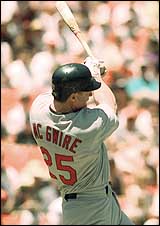 Mark McGwire, baseball's single-season home run record holder, is a favorite for tonight's All-Star Home Run Derby. (AP file photo)