


|



|
Future Spin
|
Remarkably strong and supple, spider silk will be a boon if scientists can find a way to replicate the fiber in abundance.
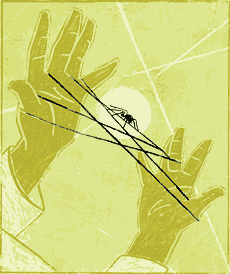 Illustration / Hadley Hooper |
 areth McKinley is a master of spin. But he is not the kind of spin doctor who makes global warming sound like a pretty good idea. He is the kind of spin doctor who receives shipments of spiders from the Miami zoo.
McKinley, an engineer on the faculty at the Massachusetts Institute of Technology, devotes a good deal of his professional life to understanding an arcane problem: how to spin materials into long, thin threads. It is an unexpectedly fascinating and important topic, which has led McKinley to ponder such diverse matters as female fertility, mayonnaise, and protecting the Special Forces soldier of tomorrow.
All of the material properties we are familiar with, such as hardness or color, emerge from arrangements of molecules that make up a substance. Scientists like McKinley are always searching for new kinds of molecules and new ways to arrange them, so that the substance has useful new properties.
McKinley wants to make a fiber as impressive as spider silk. Spiders effortlessly create a thread that is stronger, by weight, than steel yet also flexible. If spider silk were available in large quantities, it would be a sought-after material with many diverse applications, from parachute cords to artificial tendons to lighter, more effective bulletproof fabrics.
The problem is, spiders don't farm well. Unlike the docile cow, spiders tend to be both territorial and carnivorous. If you put a lot of spiders together in a pen, you don't end up with a lot of spider silk, you get a war.
So scientists are trying to copy what spiders do. In the microscopic world of molecules, the basic idea of spinning is simple: to connect long, chainlike molecules into an even longer string. The molecules begin in a liquid solution, then are shot out of a small nozzle, and -- if everything is done just right -- a strong, continuous chain forms as the liquid washes away. This is how spiders spin silk. It is also how artificial fibers are made, from polyester to monofilament fishing line to Kevlar, the textile used to make bulletproof vests.
Some scientists have been trying to spin spider silk using a scheme that sounds downright wacky. From a spider, they extract the DNA sequence that makes silk proteins, the links on the chain that becomes spider silk. Then they place this DNA into the milk-producing glands of a goat. This goat then makes a milk with spider-silk proteins in it.
Last year, scientists at the US Army Soldier System Center in Natick and a Canadian biotech company announced that they had successfully extracted the proteins, dissolved them, and then spun them into a thread of silk.
The challenge now is figuring out how to make large quantities cheaply. "There is a lot of work to be done between making a material and making a fiber," says McKinley.
McKinley is working with colleagues at MIT to understand how spider silk works at a chemical level, so they can mimic the effect without having to use spider DNA and goats.
MIT graduate students LaShanda James-Korley and Greg Pollock, who work in another lab that is cooperating with McKinley on spider research, recently presented papers at the American Chemical Society on their progress in synthesizing molecules that could be spun into spider silk.
Spinning has taken McKinley into other areas as well. All materials have a greater or lesser degree of natural stickiness to them (viscosity, in the parlance), and this is the first requirement for spinnability. In one project, he is working on understanding how the human perception of viscosity affects our experience of food. In other words, how to whip a more satisfying mayonnaise. Tastier food is always welcome, but a more serious application could help couples trying to conceive. The viscosity of a woman's saliva changes when she is ovulating. McKinley serves on the scientific advisory board of a local start-up called Boston Rheology, working on creating a simple saliva test for women to use at home.
If you talk to McKinley for a while, you start to see the history of the world in terms of spinning. You could argue that civilization began around the time of the cultivation of silkworms -- among the first animals to be domesticated -- and has proceeded to a global village, connected by the Internet's fiber-optic cables, spun out in giant reels.
Gareth Cook can be reached by e-mail at [email protected].
This story ran in the Boston Globe Magazine on 6/8/2003.
© Copyright 2003 Globe Newspaper Company.
© Copyright 2003 New York Times Company |
