


|



|
Washington Street
 Enlarge this picture Enlarge this picture
Enlarge this picture
|
 he Northampton Station of the old elevated Orange Line, like a great thoroughbred, has retired to the country.
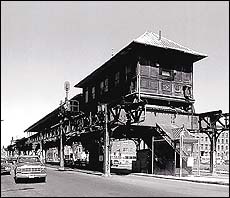
In the older photo, we're looking north along Washington Street at the corner of Northampton. We see the station shorn of its tracks and about to be taken down. Since then, it has moved from the busy South End to the peaceful grasslands of Maine, where it stands in a field in Kennebunkport as part of the Seashore Trolley Museum. George Sanborn, the archivist of the MBTA, helped save Northampton Station. He hopes that someday it will become the reading room of a new library for the trolley museum.
Once, even the most mundane civic buildings were designed by distinguished architects. Northampton is the work of Alexander Wadsworth Longfellow. He was a nephew of the poet Longfellow and was the principal designer of Cambridge City Hall and several buildings at Harvard University. Longfellow beat out 10 other architects in a contest to create a modular design for a station that could be arranged in different configurations, to fit different sites for the Boston Elevated Railway.
The late Margaret Floyd, a Tufts University art-history professor and a leading authority on Longfellow, called his modular station design "the triumph of Wadsworth Longfellow's career."
As in most such competitions, each competitor signed his drawing with an alias so the judges wouldn't know whose work they were looking at. Perhaps bending the rule, Longfellow picked the alias "Excelsior"- the title of one of his uncle's most famous poems.
Longfellow went on to design the actual stations. Northampton opened in 1901. It was a handsome building with roofs, canopies, stairs, and paneled walls, all made of copper. Architecture buffs will quickly spot the influence of the great H. H. Richardson, for whom Longfellow worked as a young architect.
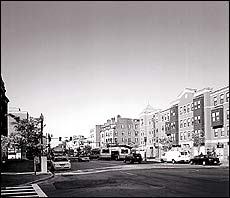
With the removal of the el, Washington Street is now bathed in sunshine. It has attracted an enormous amount of new development, most of it housing. On the right side of the new photo we see one such project, Parmelee Court, designed by architect Dan Ocasio.
This story ran in the Boston Globe Magazine on 7/13/2003.
© Copyright 2003 Globe Newspaper Company.
© Copyright 2003 New York Times Company |
