

E-mail to a friend
See what stories users are sending to friends

|
E-mail to a friend
|
   
|
|
A surreal day erases a boundary
By Eileen McNamara, 9/12/2001
On the day our security was shattered, we stood in small knots outside our children's schoolhouses, wondering how we would explain the inexplicable to the innocent.
We sat with our neighbors in front of our television screens, trying to incorporate surreal scenes of imploding office towers into our image of America.
We spoke to one another on the Red Line and on the commuter rail as we rode home early from our downtown workplaces, grasping our fundamental connection in a way we did not only a few hours before.
We did not need a sister on American Airlines Flight 11 or a son in a Pentagon warren or a wife at work at the World Trade Center to feel fragile yesterday. We did not need to have known the mother and child whose doomed airplane was to have taken them to Disneyland and the Magic Kingdom. We did not have to be the mother of one of the hijacked pilots.
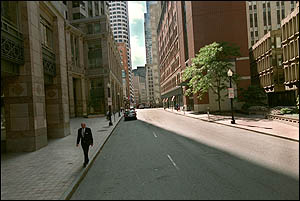
Peggy LaPrise knew that the vulnerability of the dead was her own when she could not stop her hands from shaking as she sat at her desk in the Boston Housing Authority. A Medford mother of two young children, she thought that running an errand to a nearby pharmacy might help restore some sense of normalcy, but when she saw so many solemn faces on Boston's nearly deserted streets, she burst into tears. A stranger stopped to console her.
''I have never appreciated a hug so much in my life,'' she said, the memory of a Haitian woman's brown arms embracing her pale, freckled skin bringing fresh tears to LaPrise's red-rimmed eyes.
Patrick Finn was at a similar loss when he and his co-workers were sent home from Tufts Medical School. With no certain destination in mind, he wandered down Washington Street, past the shuttered entryways of the city's downtown retailers, commerce having yielded to compassion on this extraordinary day. He stopped at the open door of the Workers' Chapel on Arch Street, where he slipped into a pew behind Peggy LaPrise.
''They've been coming in waves all morning,'' said Brother Justus, one of the Franciscan friars based at St. Anthony's Shrine in the middle of Boston's downtown marketplace. ''They don't come for answers. There aren't any answers to a tragedy like this, but there is comfort in prayer and in the company of other people.''
At a well-attended midday Mass, the Rev. Raymond Mann looked out on a fretful congregation of office workers, shoppers, and passersby and urged them to pray for ''a peace that the world cannot give. How do we respond to hatred without becoming hateful ourselves,'' he asked. ''The tendency is to respond in kind, to strike the second blow, and then the cycle of violence escalates.''
It was not supposed to happen here, not in our cities, not on our soil. Inured to the fact of pipe bombs exploding at the feet of Catholic schoolgirls in Belfast, to the sound of sirens wailing and glass breaking in the streets of Jerusalem, we thought we were immune in the United States. The Oklahoma City bombing and the prior assault on the twin towers in lower Manhattan were abberations; terrorism was a foreign phenomenon.
That fiction held until yesterday when frightened Americans had to acknowledge that terror knows no borders, that we are all combatants when the war against us is waged from the shadows.
Father Mann asked the men and women in the Workers' Chapel at St. Anthony's Shrine to pray for President Bush to find ''the wisdom, the maturity, and the integrity to respond in a way that brings peace to all the world.''
Peggy LaPrise's prayerful hopes were much more humble. ''I prayed for all the people who died. I prayed for their families. It was something I could do, maybe the only thing that any of us can do,'' she said. ''Now, I just want to go home and hug my children.''
In that, she was not alone.
Eileen McNamara can be reached by e-mail at [email protected].
This story ran on page A18 of the Boston Globe on 9/12/2001.
|
|
|

|
|
© Copyright 2003 New York Times Company |
|||||||


 e did not want to be alone.