

E-mail to a friend
See what stories users are sending to friends

|
E-mail to a friend
|
   
|
|
ON THE STREETS NYC hurt, but still unbowed
By Tina Cassidy, Globe Staff, 9/12/2001
The day was a scramble as people trying to reach relatives lined up at pay phones because cellular service was all but impossible. Finding a way out of the city was an ordeal for most, with the Brooklyn Bridge and Lincoln Tunnel closed to buses and cars. At Grand Central Station, a rottweiler patrolled for bombs and commuters ran to trains. And thousands of people evacuated from their homes in lower Manhattan desperately tried to find a hotel room. Others sought refuge in churches, waited in emergency blood donor lines or scarfed down food in a rare open pizza joint.
Mamgal Shetti, 37, was evacuated from corporate housing near Wall Street and walked about 40 blocks north to the Library Hotel, which was inundated with more than 400 calls by mid-afternoon from those seeking a bed. Shetti, looking exhausted, was told the 60-room hotel was booked. Somehow, he remained optimistic, and committed to permanently immigrating to this country from India.
''I think America is best prepared to handle things like this,'' he said. ''I think the rescue operation was great. This is a free country. I don't think that has been dampened.''
At Grand Central, transit authority police Sergeant Willie Barreto told commuters what trains would take them closest to home and said he did not expect the terrorism to change the way he - or most New Yorkers - live. He will still take public transportation, he said. Still go in tall buildings. ''We're tough people,'' Barreto said.
A few blocks north, in a long line of blood donors at the CitiGroup Center, Julia Mueller said the leveling of the Trade Center will dramatically alter the physical landscape of the city.
''My brother and I saw the twin towers going up when they were first built, and it's very strange that they're not there anymore. They're a dividing line in time: New York before and after,'' said Mueller, 38, of Queens.
Elsewhere in the city, the streets were quiet, with people released from work early walking in silence. Saks Fifth Avenue closed, as did virtually all retail shops throughout the city.
The New York fashion shows, known as 7th on 6th, were canceled, with a note taped outside the tents at Bryant Park, where the collections are displayed saying, ''We are in constant communication with the designers and looking into alternatives to assist the industry with shows and venues in New York at the appropriate time.''
The churches, however, were open. At St. Bartholomew's, a special Mass had been arranged and in the quiet cool inside, a minister prayed for the victims.
''I've never seen this place this barren,'' Robert Rosario, a 48-year-old telecommunications worker in Midtown, said outside the church.
Rosario admitted to being afraid of traveling through the Lincoln Tunnel.
''I'm from New Jersey. I see the Trade Center on the horizon every morning when I come to work. But the permanent scar is all those lives that passed away in that devastation and the families who have to live with it. On the other hand, New Yorkers move on.''
Former Mayor Ed Koch agreed that the attack would not alter the way New Yorkers live day to day, but said it could engender hatred.
''I don't think we're going to worry about getting on buses, as is the case, for example, in Israel. We're not going to avoid mass transit,'' he said. ''But then there is this feeling that I think Americans have that we're not going to submit to terror. The key is an immediate demand of turnover of terrorists. Or to pulverize their cities.''
This story ran on page A5 of the Boston Globe on 9/12/2001.
|
|
|

|
|
© Copyright 2003 New York Times Company |
|||||||


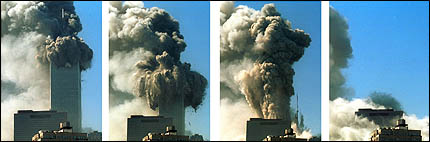 While New York and America watched the Twin Towers fall to the ground, President Bush and Americans alike have vowed not to let their faith in freedom fall along with them. (AP Photo)
 EW YORK - New Yorkers saddened and outraged by yesterday's unspeakable events vowed not to let the World Trade Center tragedy defeat them.