It's all in the game
And for hardcore players, only the finest equipment will do
By Hiawatha Bray, Globe Staff, 05/06/99
Think about technology in the home, and your mind instantly focuses on Internet access. Or wide-screen TVs. Or even cell phones possibly replacing your old, wired phone.
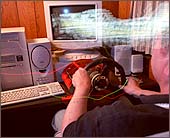 Mike Grandy drives the on-line NASCAR stock car circuit using "just perfect" ECCI steering rig. (Globe Photo / Ted S. Warren)
|
But for millions of PC and Mac users, the best technology in their homes is anything that will allow them to drive faster, shoot better, or hit a golf ball or baseball farther - all on their computers.
They're the Serious Gamers, and when it comes to their favorite hobby, they spend Serious Money.
At a time when you can get a decent home computer for $500, some Serious Gamers spend that much just on a set of computer speakers.
Others spend hundreds on fancy electronic add-ons to make the images on their screens look better, or for super-realistic steering wheels that can turn a Pentium II into a Daytona 500.
Americans spent $6.3 billion on computer games last year, nearly as much as we spent on movies. For most of us, the games provide a convenient fantasy break in the midst of a busy day. Half an hour of blowing up aliens, and then back to work. But then there's a hard core of fanatical gamers who devote every free moment to the latest digital diversions. And for these fervent players, only the finest equipment will do.
|
POWER CLICKERS
|
|
How a 3D graphics accelerator works
First, the computer's main processor sends information about what images must be drawn on the screen to the accelerator. This information travels through a computer's data bus at a speed measured in megahertz, or millions of cycles per second.
Most modern computers have a top bus speed of just 33 megahertz. But a new system called Advanced Graphics Port is becoming commonplace. AGP uses a special connection between the main processor and the 3D accelerator that is capable of sending data at 66 megahertz.
In general, the faster the data flow between the processor and the accelerator, the better the graphics performance of the system.
This information is sent to memory chips used by the accelerator. The amount of memory available to the accelerator determines the resolution, or sharpness, of the image, and the number of colors that can be displayed. An accelerator with limited memory might be able to show a very sharp image, but with only 256 colors. Add more memory, and the same accelerator would be able to show the image with more than 16 million colors, thus making the colors look richer and more realistic.
The accelerator itself is an extremely fast computer optimized for calculating the generation of three-dimensional images on the computer screen. Modern accelerators can process data in 64-bit or 128-bit chunks, compared to a Pentium processor, which can only work with 32 bits of data at a time. In addition, 3D accelerators can run calculations many times faster than standard processors, in order to generate realistic moving images without hesitations or flickering.
Finally, a digital-to-analog converter, or DAC, chip translates the digital data produced by the accelerator into an analog signal that can be fed into a computer monitor. Once again, speed matters. The faster the DAC chip, the smoother the video images are likely to be.
|
|
The first item on the serious gamer's shopping list is a top-notch 3D graphics accelerator. Despite the sexy name, an accelerator isn't much to look at - just a drab-looking circuit board covered with chips.
But these aren't ordinary chips. A 3D accelerator is actually a computer in its own right, one that's faster in some ways than the fastest Pentium III or Power PC chips. And all that power is used for just one thing - drawing realistic three-dimensional images on your computer screen.
''The key to a really, really good 3D gaming system is a 3D accelerator card,'' says Dan Amrich, associate editor of Gamepro.com, a leading computer games Web site.
The hottest modern games can make your computer screen appear to be a window into a fully realized three-dimensional world. This is achieved by constructing all the game's images out of millions of little triangles, or polygons. When a character in the game moves, all those millions of polygons change their angles. As a result, every object in the game shifts its relative position, just as you'd see while walking through a room in real life.
But to do this in a computer requires a monstrous amount of mathematics. Worse yet, for the game to be realistic, the images must change smoothly and without any delay. In other words, all that math has to happen literally in millionths of a second.
And that's what 3D accelerators do. Top-line products, like the 3Dfx Corp.'s Voodoo 3 chip, can perform 100 billion calculations in a second. Accelerators, like standard computer chips, also need memory to store the data they process. Today's high-end cards generally come with at least 16 megabytes of memory devoted solely to 3D processing. Cards like these range from $150 to $200.
Some gamers are upgrading their entire computers to get better graphics performance. That's because of a new system for connecting the accelerator to the computer's motherboard. It's called the advanced graphics port, or AGP. A computer with AGP transmits data to the accelerator much faster than with older technology.
Just as gamers want 3D images, they're also demanding 3D sound. In some newer games, like the shoot-'em-up Unreal, sound becomes a vital part of the playing experience. Players who can hear the enemy coming up behind them have a big advantage over those who rely on the cheap speakers that came with their PCs.
So Newton-based Cambridge SoundWorks is helping gamers fight back, with a line of four-channel speakers especially for computer buffs.
''We've really taken a strong position that the future in high-end audio for gaming is four-channel sound,'' says Tom Hannaher, Cambridge SoundWorks' senior vice president of marketing.
The system is designed to work with four-channel computer sound cards made by the company's Singapore-based parent, Creative Technology Inc. Four small ''satellite speakers'' are positioned around the room, with a subwoofer to provide powerful low-frequency sounds, like things going ''boom!''
The setup sells for $199, not counting the sound card. ''It's about as much as a computer person's willing to spend on speakers,'' Hannaher says.
Guess again, Tom. Some fervent computer audiophiles will spend a lot more. Eminent Technologies Inc. of Tallahassee, Fla., offers its LFT-11 speakers, listed by Computer Gaming World magazine as essential pieces of hardware for ultimate gaming fanatics. And at $500 for a pair - $600 with auxiliary amplifier - these speakers are definitely priced with the fanatic in mind.
Still, for sheer gaming frenzy, it's hard to beat the thousands worldwide who log onto the Internet to compete in auto racing tournaments. Today's high-end car racing games allow players to challenge each other on the world's greatest courses.
Graphically, these games are accurate to the smallest detail. But most players use game controllers that don't measure up. Many use mock steering wheels and pedals that plug into a computer's game port and boost the illusion of driving. But most of these devices are cheaply made, with an unrealistic feel to them. After all, building a racing wheel that would really emulate the experience of driving a race car would cost a small fortune.
And yet, there are those who are happy to pay. Business is good at Extreme Competition Controls Inc. in Minneapolis. ECCI charges up to $1,400 for its ultra-realistic racing wheels and pedals.
''It's an automotive-quality product,'' says company president Andy Cers. An ECCI wheel-and-pedal set is made of steel and aluminum and weighs 50 pounds. The steering wheel offers progressive resistance that stiffens the farther you turn it. The braking effect varies depending on how quickly you step on the pedal. You can even get a version that comes with a hand-made steering wheel produced by the Italian firm Momo, renowned for making wheels for real race cars.
Mike Grandy of Scotia, N.Y., repairs cable television set-top boxes by day and drives the on-line NASCAR stock car circuit by night. He'd never touched a computer until four years ago. Today, he's one of the top on-line racers, and he swears by his ECCI steering rig. ''It's just perfect,'' Grandy says. ''I don't even know how to describe it.''
Most people would know exactly how to describe it - wildly extravagant. But for the die-hard gamer, it's worth every dime.
ufauthor
Hiawatha Bray's technology column, Upgrade, appears in the Globe's Business section every Thursday. His e-mail address is [email protected].