Smart kitchens will have counter intelligence
Know-all technology will do everything but drink the coffee
By Beth Daley, Globe Staff, 05/06/99
*See inside the home of the future
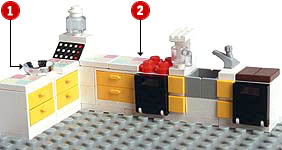 An intelligent work space
The Counter Intelligence project envisions a "self-aware" kitchen that uses intelligent objects to interact with people.
1
A built-in counter scale measures
ingredients by weight, reading their tags
to know what you're measuring.
2
In-counter sensors detect tagged
containers, "knowing" what food is
where.
Software connected to RFID sensors
could suggest recipe substitutions, track
the nutrition of your eating habits, list
the recipes for which you have
ingredients, or even order groceries.
|
|
CAMBRIDGE - Beneath a glass bowl and a jar of peanuts on the fourth floor of the Media Lab at Massachusetts Institute of Technology in Cambridge rests the single person's answer to a cooking catastrophe: an intelligent kitchen counter.
The food to be made: Peanut brittle. The question:
How many nuts? Too few means candy with no crunch; too many makes the dessert unacceptably crumbly.
Forget the recipe; just pour those peanuts into the bowl. Yawn, maybe daydream. The counter top will tell you - yes, it will speak to you - to stop when there are enough nuts in the bowl. It'll tell you to pick up the butter next, and when you've added the right amount. A few more steps and presto: perfect peanut brittle, every time.
That's the concept, anyway, behind a five-year research project at MIT called Counter Intelligence. Started last October, the kitchen of the future is being created here: Intelligent coffee machines that know to make a double espresso at 8 a.m., microwaves that know how long to cook frozen French toast to perfection, refrigerators that know exactly what needs to be reordered on grocery day.
The founding spirit behind this project is a 22-year-old MIT graduate named Joseph Kaye, whose goal is to create a completely personalized kitchen. Kaye will begin studying for his master's degree next year by donning an apron and mixing cutting-edge item identification technology with coffee, cookies, and anything else he can figure out how to make ''smart.''
Interestingly, Kaye hates the logistics of using a computer, yet loves finding easier ways for them to work - particularly getting, giving, and tracking information. And what better place than the kitchen, he says, where people spend much of their time dealing with technology that hasn't been updated in years.
Essentially, Kaye wants to turn your entire kitchen into a humming computer. Appliances could communicate with each other. Lights, for example, could flash when the washing machine reaches the spin cycle. The kitchen would track coffee gone from the pantry shelves, ice cream taken from the freezer.
|
Double latte, please
A project at MIT's Media Lab uses microchips to let objects communicate. In this case, an automatic coffee maker dubbed "Mr. Java" knows the preferences of some 30 people, dispensing their preferred drinks on cue.
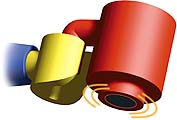
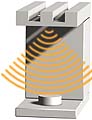
Here's how Mr. Java works:
1
On the bottom of each
coffee cup is a radio
frequency identification
(RFID) tag, about 1 1/2
inches in diameter and the
thickness of a coin.
2
A tag reader under Mr.
Java's spout emits a weak
radio signal.
3
The RFID's chip uses
energy from the radio
signal to respond with its
identification number.
4
Mr. Java's software
recognizes the ID number
and dispenses the
appropriate drink.
|
|
This is no unrealistic, futuristic pipe dream. Kaye estimates that most of the technology on which he is working could be mass-produced inexpensively within 10 to 15 years.
The technology relies on a replacement for bar codes called Radio Frequency Identification, or RFID. It's already used in automated toll collecting - like the new Massachusetts Fast Lane program in effect at the eastern end of the Massachusetts Turnpike.
Like bar codes, RFID tags contain specific information: In the case of Fast Lane, names and addresses for billing; in grocery shopping, the price of, say, a bag of potatoes.
Mr. Java, Counter Intelligence's first creation, uses the tag technology. A souped-up Acorto 2000 coffee maker, it sits in a cramped student and faculty kitchen on the third floor of the Media Lab.
About 30 people in the building have coffee cups with round RFID tags glued to the bottom of the cup. The tags contain a computer chip that holds information about the cup owner's coffee preferences. A sensor underneath the spout on the machine reads the tag and pours: latte, a little extra milk, extra large. Your special coffee, perfect every time.
Meanwhile, a computer keeps careful track of the coffee that leaves the machine, whether it goes into the special tagged coffee mugs or a visitor's styrofoam cup. It registers what type of coffee is dispensed, how much, and at exactly what time.
During a recent demonstration, Mr. Java was feeling fickle. But when running smoothly and efficiently, it is easy to see that its ability to gather specific data about individual cups of coffee has huge implications for tracking information not only in coffee shops, but in grocery stores and warehouses. It's why Kaye has companies like Kraft and Nestle underwriting his research.
Today, grocery stores keep track of items when their bar codes are scanned in at the register. But the process can be cumbersome; bar codes must be read individually and can be difficult to scan if they are dirty or torn. Meanwhile, expensive manpower must be used to take inventory of the products still on the shelves.
With RFID technology, inventory could become completely computerized and more efficient. Because the RFID tags can be read through a product and from farther away than bar codes, each item could be equipped with a tag and the shelves embedded with sensors, enabling workers to know exactly what's on every shelf at all times. Sold items can be reordered more easily, stolen items tracked more carefully, and lost items found more quickly.
What's more, the RFID technology could mean that many tags are read almost at once: Just push your shopping cart past a device that reads the tags on all your items and tallies the final price.
In the future, your kitchen will do essentially the same thing: Keep constant track of almost every item in the room.
''See it as instead of a computer on a table, you'd have a computer all around you, all the time,'' says Kaye.
The technology, particulary if it is linked to kitchen machines, may mean big business for appliance makers. Kaye is now consulting for a European applicance manufacturer.
Still, the technology is not complete and, like Mr. Java, the machines are just prototypes. And some ideas simply didn't work out, like a refrigerator with a bar code scanner: it was too cumbersome for everyday use, says Kaye.
But as he sketches out the future, he sees great things: a smart washing machine, a revised refrigerator. Kaye, a bachelor, doesn't plan on letting kitchens do all the work in the future. He adores cooking. He just wants the milk to be fresh and in the refrigerator, the flour on the pantry shelf.
But mostly, he wants the peanut brittle to be perfect, every time.
Staff reporter Beth Daley covers the Boston public schools for the Globe.