The frozen north
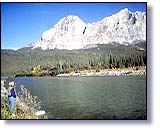
Mountains tower along the Dalton Highway between Prudoe Bay and Fairbanks. Photo credit: Bill Gleasner. |
By Diana C. Gleasner, Los Angeles Times Syndicate, 04/98
Take a trip to such legendary places as Dead Horse, the Continental Divide and Cold
Foot.
Northward Ho! Kotzebue is a fascinating place to visit, but we wouldn't want to live there.
The frozen tundra landscape is bleak, with wind-chill temperatures plummeting to 100
degrees below zero at times during the long, dark winter. Rusting hulks of various cars,
trucks and snow machines litter the small community. The Arctic Ocean is frigid, even
in August. Besides, the only Dairy Queen north of the Arctic Circle has gone out of
business.
INFO:
For air faire, call Alaska Airlines (800-426-0333) or Princess (800-774-6237).
The three-day, two-night Nome/Kotzebue Tour combines an overnight in Anchorage
with visits to the Arctic villages of Nome and Kotzebue -$649.
Click here for more information
|
|
We had signed up for a tour called ``Arctic Adventure.'' Including both Nome and
Kotzebue, it lived up to its billing. The plan was to travel by air from Anchorage to
Kotzebue, spend the day, fly over to Nome, overnight there, tour the community the
next day and then return to Anchorage.
Our day in Kotzebue was as enlightening as it was chilly (39 degrees, mid-August). At
the Inupiat Cultural Camp, we learned how native people have survived in northwest
Alaska for more than 10,000 years by using natural resources with astonishing
creativity: Moose antlers served as food platters; tundra moss was a handy substitute
for diapers. Everything was used, right down to the lining of a walrus stomach.
After lunch at the Nullagvik Hotel, complete with ocean view, we attended an
impressive presentation at the NANA Museum of the Arctic. We learned about Arctic
wildlife and Eskimo culture, listened to stories, watched dances and took part in the
traditional blanket toss.
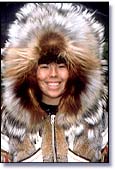
This native Alaskan in traditional garments is all smiles.
Photo credit: Bill Gleasner.
|
Weather is a very big deal in Alaska, and it often has its own plans. Sea fog kept us
from staying overnight at the Nome's Nugget Inn, but we were able to arrive by plane
the next day.
``No matter where you roam,'' a resident told us, ``there's no place like Nome.''
Nome's story is of the gold rush era, current gold-mining efforts, reindeer herding,
commercial fishing and dog sledding. Our introduction to Nome was a race between
our bus on the road and a sled dog team on the beach (The huskies won.) Afterwards,
we peppered the musher, as he was called, with questions about the Iditarod, the
legendary dog sled race across Alaska, with its finish line in Nome.
At Little Creek Mining Station, we panned for gold and were actually able to haul in
four gold flakes and a tiny nugget. We then met a personable reindeer in full velvet
who let us touch her warm antlers. Domesticated wild caribou and reindeer have long
provided food and skins for native people of the region.
Nome and Kotzebue whet our appetites for the far north. Our flight from Anchorage
provided a spectacular view of Mt. McKinley en route to Dead Horse and Prudhoe
Bay. This region, 250 miles north of the Arctic Circle, is one of the most remote areas
in North America. We flew into Dead Horse to find an August wind-chill factor of 28
degrees, and not a single horse, dead or alive.
What we did find were our motor coach and the most highly concentrated business
activity on the entire North Slope, thanks to one of this century's richest oil strikes.
Prudhoe Bay is the largest oil field in North America, currently transporting 20 percent
of the nation's domestic oil production. Here oil begins its long journey through the
Trans-Alaska pipeline to Valdez, the northernmost ice-free port in North America.
One of the largest pipeline systems in the world, this was an awesome engineering feat.
The route covers 800 miles, crosses three mountain ranges and countless rivers and
streams.
Our tour pamphlet announced that our accommodations at the Arctic Caribou Inn
were ``only those needed to support the oil field operations and though clean and
warm are of a basic nature.'' Oh boy.
The brochure did not mention the food, so the quality of our tasty buffet dinner came
as a nice surprise. We had our choice of caribou stew, onion soup, chicken marsala
with wild mushrooms, halibut with shrimp sauce, a complete salad bar, chocolate
mousse cake, key lime pie, cream brulee or Snickers pie. So much for roughing it at
the dining table.
Of all the things we learned at Prudhoe Bay, several stand out. Some folks do ``swim''
in the Arctic Ocean, though surely their sanity should be questioned. It's OK to run
when you meet a bear as long as you're with someone who is slower than you are.
And during the long, cold (56 days without sunlight) winter, spit freezes before it hits
the ground.
After a hearty breakfast and a stop at the general store to buy postcards, we boarded
our motor coach. During our trip south, we traveled the northern half of the historic
414-mile, unpaved Dalton Highway, a road totally devoid of services, as it was
designed only to be a halt road for the pipeline. No problem. We had extra fuel, a
lavatory and box lunches!
Best of all, we had John Bennetto, our eloquent driver, who entertained us with wildlife
sightings, history, personal reminiscences, legends, facts and poetry. John stopped
often to clean the windows so we didn't miss a speck of scenery. He made us laugh,
and he made us cry. And that nine-hour drive almost seemed like a mere jaunt across
town ... almost.
Gradually the Arctic Tundra gave way to the majestic Brooks Range. We stopped to
photograph a moose by the side of the road and Dall sheep on the mountainside. Off
in a distance, we spied several carabou, part of the largest herd in North America.
We crossed the Continental Divide at Atigun Pass and rolled into Cold Foot just in
time for dinner, our stalwart coach distinguished under a thick mantle of dust.
Cold Foot bills itself as ``the most northern resort in North America.'' They've taken
some liberty with the word ``resort,'' but, hey, this is the truck stop to end all truck
stops. Name it and Cold Foot has it, from restaurant, gift shop and RV park with
hook-ups, to a total of 200 beds in three motels, to the northernmost saloon.
A nightly show at the Visitor's Cabin features slides and a nature talk. Or we could just
stroll into the parking lot and shoo the moose away for fun.
On our final day, we crossed the Arctic Circle complete with celebratory refreshments
and signed certificates. By this time, strangers had become friends, and our driver
knew us each by name. We were certainly not the same group that had flown into
Dead Horse two short days earlier with a shared curiosity about the frozen north.
As our bus approached Fairbanks and the bright lights of civilization, we just kept
wondering about that moose in the parking lot. But the leaves had turned yellow, and
winter was setting in.
INFORMATION:
Tours and Rates: Although it would be possible to arrange your own travel to these
remote areas, this article was based on Arctic land tours offered by Princess Tours in
conjunction with Alaska Airlines. Arctic tours depart from Fairbanks or Anchorage
during the summer months. Prices are per person, double occupancy for peak season,
and include transportation, tours, some meals and accommodations for two nights.
The three-day, two-night tour to Prudhoe Bay crosses the Arctic Circle and includes
overnight stays at Prudhoe Bay and Coldfoot in the Brooks Range. Passengers travel
one way by motorcoach between Fairbanks and Prudhoe Bay along the Dalton
Highway, and the other way by air or they may do the trip in reverse -- $599.
The three-day, two-night Nome/Kotzebue Tour combines an overnight in Anchorage
with visits to the Arctic villages of Nome and Kotzebue -- $649.
Weather: Summer temperatures range from 28 degrees F. to 60 degrees F. and can
change quickly.
Dress: Dress is casual and should include a warm jacket and comfortable walking
shoes. Bring your sunglasses for 24-hour daylight as the summer sun does not set from
mid-May through mid-July.
For more information, contact your travel agent, Alaska Airlines (800-426-0333) or
Princess (800-774-6237).
(Diana C. Gleasner is a free-lance travel writer in Denver, North Carolina.)
© 1998, Diana C. Gleasner. Distributed by Los Angeles Times Syndicate.