The far side of Australia
By Margo Pfeiff, Los Angeles Times Syndicate, 04/98
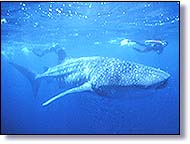
Reef monster: Snorkeling above a whale shark off the Coral Coast. Photo credit: Jim Hutchinson.
|
Snorkelers head out into the blue Indian Ocean to swim among whale sharks, clown
fish and strange wobbygongs, then take a four-wheel-drive safari to see stunning
coastline, gorges, ancient caves and fossilized brain coral.
EXMOUTH, Australia -- ``Jump!'' shouts Tony Medford, and in a collective splash
six of us snorkelers leap into the blue Indian Ocean. It is April, and the water is slightly
murky, but that is why we are here. The water this time of year is rich with plankton, a
magnet for the beasts we are tracking.
INFO:
The best time for a visit is from April to September. In the U.S., call the Aussie Helpline, (805) 775-2000, fax (805) 775-4448.
Click here for more information
|
|
Suddenly, I spot one. Looming out of the blue, the creature is so big I bite down on
my mouthpiece. Casually drifting by 6 feet below me is a 30-foot-long behemoth with
a smattering of white speckles across its broad head. Its mouth is open wide as it sifts
the water for microscopic plankton. It's a whale shark, a gentle giant that is the biggest
of all fish.
This king of fish, which can reach lengths of 50 feet and weigh 11 tons, is found in
deep waters around the world. But nowhere else do they appear so predictably or so
close to shore as here around Ningaloo Reef off the coast of Western Australia, about
800 miles north of the state capital of Perth.
This region is called the Coral Coast, a spectacularly remote spot where the red sands
of the Australian outback meet the warm waters of the Indian Ocean. Its heart is the
North West Cape, a finger of land jutting north into the sea. We were snorkeling in
Ningaloo Marine Park, protected waters that contain one of the largest reefs in the
world that is situated so close to land. The rugged landscape of the peninsula itself is
also protected as part of Cape Range National Park.
Exmouth is the small community (population 2,300) near the tip of the peninsula that is
the tourist center of the area. It was founded in 1967 as a support base for the nearby
U.S. Naval Communications Station. This is a true outback town: Emus regularly
come to drink from backyard birdbaths in the mornings and perenty lizards -- 1 to 2
feet long -- are frequent guests on front lawns. When frightened, they run fast, straight
for the nearest high point, which is, on occasion, a human being; gripping hard with
sharp toenails they perch atop a person's head.
Rest stop: Parrots in Cape trees. Photo credit: Jim Hutchinson. |
There are plenty of military connections in this remote corner. The lovely 1912
Vlaming (CQ) Head Lighthouse just outside of Exmouth stands alongside the ruins of a
World War II-era radar site. Learmonth Airport, to which my flight from Perth
brought me, was a former military airfield, part of Operation Potshot, a World War II
submarine refueling depot that was bombed by the Japanese three times during the
war.
The best time to visit this area is from late March to September, when temperatures
range from the mid-70s to the mid-80s (the rest of the year, the wet season, cyclones
and hot, muggy weather are common).
In mid-March -- not long after the 160-mile-long Ningaloo Reef undergoes its massive
annual spawning, when the entire living reef releases masses of eggs and sperm on a
single day -- whale sharks begin appearing. The event is connected to an increase of
plankton, the chief diet of the filter-feeding sharks, who stay close to shore until
roughly mid-May, when they disappear back into the deep.
Snorkeling among whale sharks is an expensive sport; a day trip, including snorkeling
gear and lunch, costs about $150 per person. Our group of about 10 -- mainly
Australians and British, plus a couple of Americans, rare in these parts -- were on a
dive boat run by Exmouth Diving Centre. Tony Medford has run the company, one of
the biggest and best-equipped operators in town, since he thought up the idea of
taking tourists out to snorkel with whales sharks in the 1980s.
It works like this: In the morning a spotter plane is sent up to track whale sharks in the
ocean below. Meanwhile, we snorkelers head out to sea. When word comes over the
radio, the boat is alerted and we speed over to the whale shark and are dropped
quickly into the water.
Because whale sharks swim close to the surface, nothing more than a snorkel is
needed to swim with the beasts, whom tour operators claim are relatively harmless
despite their size. We follow, furiously beating our fins until we can't keep up. Then the
boat picks us up, overtakes the whale shark again and back in the water we go. The
fish carries on as though we don't exist; we get back in the boat and reel with
adrenaline.
There are plenty of excellent dive and snorkeling trips out of Exmouth. Experienced
divers consider one of the best dive spots in all of Australia to be on the old U.S.
Navy Pier, where we headed the day after our whale-sharking adventure. Exmouth
Diving is the only operator with access to the pier. Although we dived in only 35 feet
of water, the pylons and cross bars of the abandoned 1964 pier are encrusted in
brilliant coral of every color. The fish life is even more abundant and diverse than the
coral, with clouds of lion fish, cod and groupers, barracuda, parrot fish and strange
wobbygongs (shaggy looking local shark with tassels hanging across their mouths) and
toadfish. I saw more varieties here than in two straight weeks of diving on Australia's
famed Great Barrier Reef.
That evening, after looking at all that sea life, it only seemed appropriate to dine on
seafood. Exmouth eateries are rather limited -- your basic Chinese take-out variety --
so our group of newly anointed whale sharkers headed 15 miles down the coast. We
bought a packet of fresh cooked prawns at MG Kailis Fisheries, salads at a
delicatessen and Australian white wine at a ``bottle shop,'' and enjoyed them while
watching the sunset on the beach.
There's plenty more to this area than underwater attractions. Much of the North West
Cape is part of Cape Range National Park, a 123,500-acre low limestone ridge with
canyons and eucalyptus forests. Here, I changed from flippers to hiking boots to join a
full-day, four-wheel-drive safari that took me and a group of Aussies visiting from
Melbourne on a 150-mile drive from gorges to coast.
I sign on with Neil McLeod, a real Aussie bush character who has been bumping
along these dirt tracks (most of them built for oil exploration in the 1950s) for 11
years. McLeod, who runs Ningaloo Safari Tours, is 43 and a bit shy.
The ridge that makes up Cape Range is pocked with more than 600 caves. Some of
the routes within the park, such as the Charles Knife Road, run along very narrow
ridge tops; not for the faint of heart. We left early in the morning and drove first to the
worn gash of Shothole Canyon, named after the explosive set off by oil exploration
teams. You wouldn't take the family sedan on any of these tracks, but Neil drives an
Aussie original, called an Oka, that looks something like a four-wheel military bus and
carries 13 passengers. (Okas are made in Perth and feature an English turbo engine
and an American gearbox.)
You can't go far in Australia before it's tea time. Accompanying a pot of billy tea --
Australian bush fare that's tea leaves and boiling water served in a camp teapot that is
swung around to mix the brew -- we snacked on a boiled fruitcake made by Neil's
80-year-old mother. Along the way, McLeod introduces us to a land of 6-foot-long
monitor lizards, scrub turkeys, families of emus scurrying across roads and kangaroos
munching in fields. About an hour after tea, after traveling over bumpy track, we came
to Owl's Roost Cave, which has a huge native fig tree growing straight out of its
opening. We clambered down to see stalactites; scientists estimate the age of this cave
to be 109,000 years old based on the calculation that stalactites grow about .7
millimeters every 1,000 years, McLeod told us.
McLeod knows his bush tucker (native foods), too. He points out the kurrajong, a fig
tree much loved by the area's Aborigines; a native orange tree; and the honey
grevilleas tree, from which the Aborigines retrieve a honey-like liquid.
We have steadily been moving west toward the Indian Ocean, and we finally reach the
sea at Turquoise Bay. Here we strap on snorkels, masks and fins once again and hit
the water on a spectacular stretch of reef. Just 30 feet from shore, we see spotted
rays, a giant clam and clown fish. Three days earlier here I had glimpsed a dugong, a
cousin of the Florida manatee, in less than 6 feet of water. This region was once
known for whaling and turtle hunting (both species are now protected), and McLeod
takes visitors on turtle expeditions at night during the egg-laying season, November to
March. Humpback whales can be spotted off the coast from August through October
when they are migrating to and from Antarctica.
When it was time for lunch, we helped ourselves to salads and made our own giant
sandwiches out of fresh corned beef prepared by McLeod's wife, the best corned
beef I've ever eaten. (Meals are included in the safari's $55 per person price.)
In the afternoon, we boarded a small boat at the foot of Yardie River Gorge, where
we drifted between orange limestone walls in the steep canyon, spotting osprey nests
set high in the cliffs. White parrots gathered in the gnarled gum trees twisting out of the
gorge walls. And if I didn't have someone to point them out to me, I would never have
noticed a gorgeous little pod of black-footed wallabies, an endangered creature that
resembles a miniature kangaroo.
One last detour on the way back to Exmouth was at Shark Tooth Ridge. Neil
clambered up a hill to point out alongside fossilized brain coral, where you could still
make out the convoluted ridges, a white tooth from a pointer shark that had been
fossilized in the stone. Six inches long with steak-knife serrations, it must have
belonged to an ancient ``Whitey'' -- a great white shark -- that scientists believe could
have been 30 to 40 feet long.
I set out early the next morning to drive from Exmouth to Coral Bay, a small
community at the southern end of the peninsula. Fog shrouded the termite mounds that
rise like bizarre red-earth monuments on an other-worldly landscape. In the outback, it
seems that at daybreak all the world is out looking for breakfast: sheep, kangaroos,
emus and, in the huge gum trees lining dry water holes, thousands of shrieking white
parrots.
I'd come to snorkel with manta rays at Coral Bay. A short boat ride
from shore, a group of them, great black diamonds with a long tails, had gathered in
15 feet of water. I glided above them, watching their graceful moves as their mandibles
formed into scoops in order to feed on plankton.
Coral Bay is a collection of motels, trailer parks, campgrounds and shops. But tucked
amid them is Fins Cafe, a small, casual outdoor diner run by Damon De Ruiter, who is
also the chef. A few years ago De Ruiter and his wife, who is the pastry chef, set out
on their honeymoon to tour the country for a year on a Harley Davidson motorcycle.
Arriving in Coral Bay, the De Ruiters found no decent restaurants, despite a plethora
of fresh seafood.
The menu at Fins Cafe combines Asian cuisine -- from De Ruiter's cooking experience
at an up-market Melbourne Japanese restaurant -- with great local seafood. I grabbed
a bottle of cold white wine at a nearby pub (the cafe doesn't sell liquor) and took a
table under the palm trees to spend a wonderful afternoon.
That afternoon, I steered my rented four-wheel drive along a bumpy dirt track to
Giralia Station, a working outback sheep farm. The sheep station also serves as an inn
and is run by Rae and Denver Blake from a charming 1916 ranch house on 686,000
acres.
The Blakes run 25,000 head of sheep and host up to 50 guests in all types of
accommodation in the shearer's quarters or camping on the grounds. At Giralia, the
sheep are mustered from October to December. ``Visitors are disappointed when we
aren't shearing year-round because they want to see it,'' Rae Blake told me over a
beer on the cool of a veranda. Despite 20 years of regular visits to Australia, I've
managed to miss a shearing because I've always arrived at sheep stations after the
shearing season (generally in October).
On this trip I got lucky. Two wool brokers from Perth, making the rounds of sheep
ranches to look at quality wool to purchase, were also staying at Giralia. ``We're off to
Mindaroo Station tomorrow, and they're shearing over there,'' said one, Neil
Crawford. ``Tag along if you like.''
At Giralia, days start at 5 a.m., by which time Rae is already feeding the station
workers, called jackeroos. After breakfast, I boarded a small plane parked out in the
paddock; the wool brokers had chartered it to ferry them between sheep stations.
Less than a half-hour later we landed at Mindaroo Station and strode into a
corrugated iron building that served as a shearing shed. Sheep bleated against the
background of country and western music from a radio as shearers went about their
backbreaking work. The workers are paid by the sheep, more for rams who are
bigger and more ornery than the female.
By late afternoon, we headed back to the plane. A small crowd of station hands and
shearers had gathered in the paddock to see us off. Waving, they lifted their hats as we
flew off in a big red cloud of dust, and the pilot dipped a wing as we turned and
headed into a brilliant Coral Coast sunset.
INFORMATION:
You must first fly to Sydney (a 14-hour flight), then to Perth (five hours). Qantas and United offer nonstops to Sydney from most major cities; Qantas and Ansett fly
between Sydney and Perth. Lowest round-trip fare is $2,019. Ansett flies from Perth
to Exmouth for about $200 round trip; you can rent a car at Learmonth airport. When to go: The best time for a visit is from April to September.
Where to stay: The Potshot Hotel Resort (tel. 011-61-8-9949-1200, fax
011-61-8-9949-1486), where I stayed, is clean, unfancy Holiday Inn-type lodging.
Rates: $65-$92 per double. Giralia Station (tel./fax 011-61-8-9942-5937) offers
lodging and meals in the ranch's main house for $54 per person nightly.
Outings: Whale sharking trips with Exmouth Diving Centre (tel. 011-61-8-9949-1201, fax 011-61-8-9949-1680) cost $148 per person per day, including snorkeling
equipment and lunch; an extra scuba dive costs $20 more. Coral Bay Adventures (tel. 011-61-8-9942-5955) specializes in snorkeling with manta rays; $50 per person. For
land safaris, Ningaloo Safari Tours (tel./fax 011-61-8-9949-1550) charges $55 for a full-day tour, including lunch.
For more information: In the U.S., call the Aussie Helpline, (805) 775-2000, fax (805) 775-4448.
(Margo Pfeiff is a free-lance travel writer in Montreal, Canada.)
© 1998, Margo Pfeiff. Distributed by Los Angeles Times Syndicate.