A Canadian fishing paradise
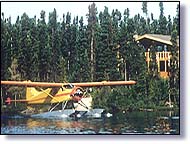
A float plane is the only way to North Knife Lake
Lodge. Photo credit: Harv Sawatzky. |
By Edythe Preet, Los Angeles Times Syndicate, 04/98
In the polar bear capital of the world, there is tranquillity, a chance to view the
Northern Lights and the irresistible lure of big trout and pike fishing.
The Champs Elysees. Rodeo Drive. The Ginza. Copacabana Strand.
To the world's list of illustrious addresses, I'd like to nominate an addition: 97W
longitude by 58N latitude. It's all a bush pilot needs to home in on North Knife Lake Lodge, a fly-in fishing paradise in Canada's Manitoba province just south of Churchill,
the polar bear capital of the world.
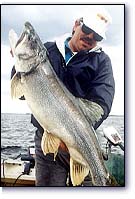
Lucky guy: Fisherman
Bob Mehsikomer lands a trout in the 30-pound range. |
Life is a series of choices. Consider sound. You could choose the buzz of several
million people, the rumble of congested traffic, the persistent jangle of the telephone,
and nonstop music pouring from stores, cars, elevators, offices and home stereo units.
You could just as easily opt for the silence of a countless million spruce trees, wind
swooshing through branches, water lapping at a virgin shore, and the occasional
mournful cry of a loon.
If the siren song of peace and solitude calls you, North Knife Lake Lodge will fill the
bill beyond your wildest dreams. Fisherfolk wax poetic over the enormous pike and
trout that all but leap onto your lines. Less industrious guests luxuriate in the silence.
Nothing breaks the spell. No phones. No television. Not even a radio blemishes the
serenity.
The great outdoors is not my usual style, but the lure of tranquillity and big fish was
irresistible. My first morning revealed you can take the girl out of the city, but you can't
take the city out of the girl. As I wolfed down homemade cinnamon buns, sausages,
omelet and Manitoba's Red River cracked wheat hot cereal laced with cream and
maple syrup, owner Doug Webber chatted with a group of businessmen who had
come for some trophy fishing. The topic of conversation was a beaver that had arrived
the night before.
It didn't seem so remarkable. Canada's beaver population has been famous since the
18th Century when the Hudson Bay Company supplied pelts for European fur
fanciers. I voiced my bewilderment, and blue eyes brimming with contained
amusement at my wilderness naivete, Doug explained they were talking about a slightly
different beast-- the red and yellow Beaver pontoon plane moored beside the dock,
lifeline to civilization in the isolated north.
Fortified by my hearty breakfast, I headed out for a morning of earnest trout pursuit
with my two companions, both serious fisherwomen.
Our Cree guide Tom knew every nook of the 36-mile lake and steered the aluminum
skiff to one of his favorite spots. Almost immediately, Colette whooped and caught the
first fish. Moments later, Anita calmly bagged another.
I valiantly attempted to catch my own specimen. I cast and reeled. I changed lures. I
prayed to the fishing gods. I watched the fish shake off my hooks and chase my line
right up to the boat. The trout knew I was out of my league. After three hours of
fruitless striving, I put my pole aside and said, ``You catch fish. I'm catching rays.''
With that, I lay across the bow and soaked up some surprisingly hot subarctic
sunshine.
At noon we putted to a sandy cove where Doug had built a crackling fire. Tom
skinned and filleted the morning's catch with lightening quick surgical precision. Helen
Webber and long-time friend Marie Woolsey ran the show. Authors of a great
collection of North Woods recipes entitled ``Blueberries and Polar Bears,'' the ladies
soon had potatoes and onions, baked beans, cut corn, and luscious golden trout
sizzling in black-iron frying pans. Big crisp chocolate chip, peanut butter and ginger
cookies topped off the meal. Breakfast should have held me for a full day, but for
some strange reason I was starving.
Begging off the afternoon's fishing foray on the grounds of being a rank amateur, I
hitched a ride home with the shore lunch crew. Along the way we stopped at a
deserted Cree encampment. The remains of several wooden structures stood on a
bluff overlooking the lake. An abandoned hand-hewn child's sled rested beside one of
the gaping doors. I tried to imagine what it had been like to spend a frigid winter in one
of the tiny cabins, snowed in and surrounded by ice, utterly alone in a vast white
landscape. A chill ran through me like a blast from the north wind.
Back at the lodge, I pulled a novel from my valise, snitched two cookies from the
larder and hauled a chair out onto the wide second-story veranda. The sweeping view
was a study in greens and blues. Gently swaying spruce trees cascaded down to the
sandy beach and sapphire blue lake. Dense evergreen forest stretched in all directions.
The tightly bunched vertical lines resembled an immense mossy welcome mat. Jagged
treetops etched a ragged horizon line under an endless azure sky.
For a while, sounds of dinner being prepared filtered up from the kitchen. Then all was
still. Had a mouse crept across the balcony I would have heard its tiny nails striking the
wood planks. Time stretched like soft taffy. Silence settled around me like thick cotton
batting. Hours later the sound of approaching outboard motors warned I'd better be
quick if I wanted a shower of chemical-free, silky soft, solar-heated lake water before
chow.
At such a northern latitude the sun doesn't set until midnight. As everyone munched
house-smoked trout canapes and traded fish stories, slanted sunbeams turned the
lounge into a symphony of muted browns and gold. Walls and high open ceilings
glowed with lustrous hardwood paneling. Oversize leather sofas and armchairs
alongside a massive river-rock fireplace offered cushy invitations to investigate piles of
photo albums illustrating the evolution of this hideaway from the felling of the first tree
some 20 years ago, a formidable task in a land where there are no roads.
It took four years to build the sprawling 6,000-square foot chalet. Long before its
half-mile-long sand runway was constructed, planes hauling lumber and supplies made
late spring landings on the frozen lake. Forty loads of materials were ferried ashore by
boat, snowmobile and tractor.
What fit in a DC-3 cargo hold determined the logistics. Beams were restricted to 24
feet. A truck was cut in half, taken apart, then reassembled and welded on site. A
caterpillar was brought in via a ``winter road'' -- tundra jargon for blazing trails in
sub-zero temperature across snow-covered terrain and frozen bodies of water.
Dinner was a North Woods feast. Grilled goose breast stuffed with jalapeno peppers
and slivers of Canadian bacon. Crunchy hunks of Parmesan-crusted potatoes. Lightly
sauteed zucchini with herbs plus a crisp spinach salad, courtesy of the Beaver's supply
flights. Over the show-stopping dessert of wild blueberry cheesecake, Anita and
Colette made a pact to get up at 2 a.m. to see nature's fireworks -- the Northern
Lights.
Insistent buzzing intruded into a dream where I had just landed an enormous fish. A
hand clapped me on the shoulder and I thought I was being praised for my
extraordinary skill. But it was only the alarm clock and Anita waking me to come
watch the show.
We trooped out to the dock and sat with our feet dangling in the cool water.
Overhead a zillion stars peppered the blue-black sky. In the far distance, eerie pastel
swaths of light swirled through the stratosphere; we were mesmerized by the majestic
display.
Surrounded by tall trees that reached for the heavens, it felt as if we were sitting in a
great open-air cathedral. Suddenly a splash broke the silence. My fishing buddies
smiled knowingly. Time for sleep.
Thousands of pike and trout were waiting for us to come find them in the morning.
INFORMATION:
The season: mid-June to mid-August only.
The price: $3,500 US -- five days including all meals, host bar and round-trip air fare
from Thompson, Manitoba, Canada.
Extras: Fly-out day trips to Churchill and remote fishing sites available by special
arrangement.
Making contact: North Knife Lake Lodge, Doug and Helen Webber, owners, 26
Selkirk St., Churchill, Manitoba, Canada. Tel. (204) 675-8875, toll free from the U.S.
(888) 932-2377, fax: (204) 675-8876, e-mail: swebberdigistar.mb.ca.
(Edythe Preet is a food and travel writer in Los Angeles, California.
© 1998, Edythe Preet. Distributed by Los Angeles Times Syndicate.