Voyage of the Santa Cruz: Logbook of a cruise adventure
By Anne Z. Cooke, Los Angeles Times Syndicate, 05/98
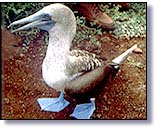
Blue-footed booby meets white-laced tennis shoes. Photo credit: Steve Haggerty. |
In the Galapagos Islands, there is the search for wildlife to see red- and blue-footed
boobies, courting frigate birds, iguanas and giant tortoises.
PUERTO AYORA, Galapagos Islands -- We've just finished reading Charles
Darwin's notes on the Galapagos from the ``Voyage of the Beagle,'' and not a moment
too soon.
The pilot says we're approaching Quito, the capital of Ecuador, ending the first leg of
our journey. Tomorrow we fly to Guayaquil and from there to our destination, the
Galapagos Islands, 600 miles to the west. By noon we'll be sailing on our own voyage
of discovery, a four-day cruise on the 90-passenger Santa Cruz.
|
INFO:
Booking a cruise: Four-day cruises range from $557 to $978 per
person, in low season (March 16-June 14, and Sept. 1-Oct. 31), depending on the
type and size of cabin. Rates range from $858 to $1,529 in high season. Prices
exclude airfare to or within Ecuador ($290-$378 for the latter), bar charges and the
$80 national park entrance fee.
Click here for more information. |
|
Funny that we'd never thought of the Galapagos as a cruise destinpelago, with 19
larger islands and numerous islets, is bigger than we'd realized. Ships like Darwin's
Beagle -- and now the Santa Cruz -- are the only commercial inter-island
transportation.
Not everyone who comes here takes a cruise, however. My Ecuadorian seat mate,
Jorge, who sees me reading, says that when he brings his family they stay in a hotel on
the island of Santa Cruz and take day trips to various National Park landing sites.
``You spend more time sailing back and forth, so you need a strong stomach,'' he
warns. The waves are rough sometimes. ``After flying so far, that's definitely not our
style.''
Our main interest is the animals, of course, amazing creatures, according to a friend
who was here last year. ``A blue-footed booby blocked the path and untied my
shoelaces,'' she gushed when she heard we were coming. ``He was so cute!''
During this cruise we plan to keep a log of our own, as a reminder. If what they say is
true, these islands are like no others on earth.
June 1: We landed this morning on Baltra, where a taciturn inspector stamped our
passports with the Galapagos seal, a much coveted trophy, judging from the crowd
which pushed forward with passports held open. The ship's bus waited outside, our
first chance to meet our fellow passengers -- various Japanese, French, Germans,
Argentineans and Texans. We are 39, joining the 19 already on board for the
one-week cruise.
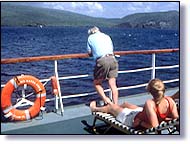
Sunbathing on the top deck off the coast of James Island. Photo credit: Steve Haggerty. |
The Santa Cruz was anchored offshore, a small white ship with a shaded sun deck,
two lifeboats and the workaday look of a research vessel. Plain but new, it's the
largest passenger ship in the islands, fitted with small but comfortable cabins, each with
a private bath. Considering the spartan decor, our first dinner was a welcome surprise,
with lots of fish, fruits and vegetables.
The crew held an orientation meeting and divided us into groups of 16, the size of a
single panga, the rubber Zodiac-style landing crafts. We English-speakers are the
Dolphins -- and proud of it. Others are the Boobies, Penguins, Tortoises, Iguanas and
Sea Lions.
The Santa Cruz sails at night and anchors during the day at seven ``visitor sites,'' where
we'll go ashore with a naturalist to search for wildlife. The Lonely Planet guide to the
islands -- everyone's reading it -- says that only three percent of the land here is
private, with towns and farms. The rest was folded into Galapagos National Park
when it was founded in 1959.
Other revelations: The islands are on the equator, but have definite seasons. Despite
occasional rain, which greens up an otherwise arid landscape, January to June are the
warmest months, and best for snorkeling. The weather cools during the second half of
the year.
June 2: We were initiated on Seymour this afternoon, a fantastic thrill! A blue-footed
booby, the size of a large duck, waddled down the path into the middle of a crowd,
peered down at the tennis shoes encircling it, then stopped, curious. By the time we'd
moved on to a colony of frigate birds, that booby was the center of hundreds of
photos.
Seymour, less than a mile square, was low, flat and covered with scrubby green
bushes, the result of recent rains. The male frigate birds were courting, hunkered down
on their nests as we walked up close to look at their red throat pouches, puffed up like
balloons.
``Each male inflates his pouch to the largest possible size, hoping that one of these
lonely females will think his is the biggest and best,'' said our guide, Emma Ridley, 27,
one of six naturalists based on the Santa Cruz. As she spoke, hundreds of birds, males
and females, circled overhead, diving and screeching.
The birds are as tame today as they were in 1535, when Tomas de Berlanga
accidentally blew ashore. By the time Darwin arrived, 300 years later, passing sailors
had killed thousands. Yet the birds were as trusting as ever.
``The birds are strangers to man,'' wrote Darwin, who spent only five weeks here.
``So tame and unsuspecting were they that they did not even understand what was
meant by stones being thrown at them ... . They approached so close that any number
might have been killed with a stick ... . A gun is here almost superfluous.''
June 3: Saw a variety of landscapes today, and added a half-dozen new check-marks
on our ``Wildlife Sighting List.'' Landed on Isla Bartolome, a barren, cone-shaped
volcano where we climbed to the top, about 375 feet, on wooden stairs. Bartolome,
like all the islands, is the tip of a tall volcano, with panoramic views from the summit.
At the next ``wet landing'' in a sandy cove, Ridley spotted four Galapagos penguins,
little fellows with black backs and white stomachs who watched as we snorkeled up
and popped our heads out of the water.
``Their coloration is an adaptation,'' Ridley said. ``When their backs are turned they
blend into the lava, and when they face the water, enemies below see what looks like
light.''
Later, a pair of sea lions zoomed up to our masks, peered in, then twirled and whirled
around us, every somersault an invitation to play. They made the boobies look like,
well, like boobies.
During lunch, the Santa Cruz sailed to Puerto Egas on James Island, where we hiked
over an ancient lava flow to tidal pools and grottos hollowed out of wave-scoured lava
tubes. Every little niche was home to something: sea lions, fur seals, marine iguanas,
herons, gulls and brilliant orange Sally Lightfoot crabs.
After lingering over dinner (dinners are served -- other meals are buffet), we moved to
the lounge for a round of Pisco Sours, a lethal brew of grenadine, lime juice and a local
Andean liquor, and a short performance by Eduardo Neira, the Santa Cruz's captain,
who strummed the guitar and sang. Then everyone gathered to rehash the day, with his
or her favorite animal story, tales that grew sweeter in the telling.
June 4: A long sail last night over ocean swells to Tower Island, crossing the equator
on the way. As the Dolphins are a hardy lot, no one was seasick.
``The seas are roughest from August through October,'' said Peter Karch, the ship's
purser. ``But most people adjust very quickly.''
Tower Island has a huge round bay and steep cliffs -- like Santorini, in the Aegean Sea
-- which we scouted in the panga, finding fur seals on ledges and red-billed tropicbirds
nesting in crevices. Landing at Darwin Bay Beach we splashed ashore to find a colony
of swallow-tailed gulls raising chicks in the rocks not 20 feet from their enemies, an
army of frigate birds.
One of our group slipped on the jagged lava and cracked his camera, though he was
wearing the recommended footwear, rubber sports sandals. It was an unfortunate
accident, since Tower, a haven for blue- and red-footed boobies, masked boobies
and short-eared owls, is a photographer's dream.
There was a sudden rush after dinner to buy souvenir T-shirts and bathing suits, a sure
sign of the coming end of the cruise. Tomorrow we disembark at Puerto Ayora, a
town on Isla Santa Cruz.
June 5: Arrived at dawn to the sight of land and a sweet, fresh breeze, and took the
panga ashore for the last time to tour the Charles Darwin Research Station, a private
foundation subsidized by Americans. The giant tortoise facility here, two miles from the
harbor, has a dozen or so giant tortoises in fenced exhibits in the forest, but it seems
pathetically under-staffed and under-funded.
The Ecuadorian government earns $4.8 million annually from park entrance fees
(60,000 visitors, times $80, the cost of the entrance fee) but they're apparently not
spending it here. Still, we couldn't leave without seeing the antediluvian reptiles which
now survive in the wild on only a few islands.
``Ten million were carted away over the years,'' explained Ridley, ``some for zoos, but
mostly for food. The sailors stacked them up six or eight deep in ships' holds, where
they could live for a year or more.''
Darwin reported encountering some leviathans strong enough to carry a man's weight
and weighing more than 200 pounds, and several of these looked that big, though the
rules forbid anyone trying. The nursery, in a separate building, raises baby tortoises to
be ``repatriated'' to their home islands.
As we drove north over Isla Santa Cruz to the airport, we suddenly felt sated with
strange creatures. Four days at sea was enough. But Emma Ridley put it all in
perspective.
``In the Galapagos you don't just see animals, but animal behavior,'' she said. ``Where
else can you watch boobies or iguanas or sea lions going about their daily routines as if
you weren't there at all?''
INFORMATION:
When to go: The best and most affordable months to go are March through May, the
low season. High season in the Galapagos is June through August, coinciding with
summer vacation in North America.
The rainy season is January to June, with intermittent showers, and calm, clear, warm
water (up to 75 degrees Fahrenheit). January and February can be hot and humid.
March through May is mild.
June to December is the dry season. June to August are cool and dry; from August
through October the water gets rougher and colder, dropping as low as 62 degrees
Fahrenheit, and the ``garua,'' a local fog, often envelopes the islands.
Booking a cruise: Four-day cruises range from $557 to $978 per
person, in low season (March 16-June 14, and Sept. 1-Oct. 31), depending on the
type and size of cabin. Rates range from $858 to $1,529 in high season. Prices
exclude airfare to or within Ecuador ($290-$378 for the latter), bar charges and the
$80 national park entrance fee. Children 7-11 go half-price; the Santa Cruz doesn't
accept children six and under.
Metropolitan Touring, owner of the Santa Cruz and four smaller ships, also offers
three- and seven-day cruises, and various cruise-land tour combinations. Book
through their American subsidiary, Adventure Associates, tel. (800) 527-2500, or
your travel agent.
(Anne Z. Cooke is a free-lance travel writer in Los Angeles, Calif.)
© 1998, Anne Z. Cooke. Distributed by Los Angeles Times Syndicate.