An urban gem that glows with a rich legacy
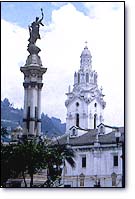
A view of the Plaza Mayor, also known as Plaza de la Independencia, in honor of
the monument erected there in 1906. Photo credit: Anya Cristina.
|
By Susan Price, Los Angeles Times Syndicate, 05/98
Once the northern capital of the Inca Empire, Quito has extravagant ``gold''
cathedrals, monasteries and cobbled streets, and is set almost two miles above sea
level, nestled between the snow-capped Andes mountains.
Once the northern capital of the Inca Empire and later the site of the Spanish
Conquest, Quito is an urban gem that glows with a rich legacy of extravagant
cathedrals, monasteries, cobbled streets and flowering plazas displayed in a setting of
snow-capped peaks. In the 16th and 17th Centuries, colonial builders designed
churches, monasteries and mansions creating this high Andean city that has been
designated a World Heritage Site by UNESCO.
|
INFO
When to go: June, July and August.
Hotel rates: International luxury hotel rates begin, depending on the season, at about
$195 for a single room, and continue to about $290.
Click here for more information. |
|
Almost two miles above sea level, ``Quito, two steps away from heaven,'' as the
natives say, is nestled between the two ranges of the Andes that run parallel through
the middle of Ecuador. Since this city of nearly two million is just 15 miles south of the
equator, the sun rises at 6 a.m. and sets at 6 p.m. year-round. The altitude balances
the country's proximity to the equator, blessing the city with a climate of eternal spring
with a dry season from June to October.
The old and new sections of Quito stretch haphazardly along the base of the active
Pichincha Volcano. The summit of Pichincha and the anonymous mountains which
form part of the Andes provide Quito with a superb backdrop in the evening. From
the top of Panecil, where the Indians went to worship the sun and where a winged
statue of the Virgin Mary has been erected, the city can be seen marked with lines of
light that lead up to the edges of the foothills.
Tunnels, jerry-built mini-expressways, crossing bridges, supermarkets and impersonal
hotels have been built in the residential north of the city but have nothing in common
with the relatively intact old city. To recapture something of old Quito, the city is
restoring streets to their original names: the Street of Forges, the Jewelers' Street, the
Street of the Seven Crosses, the Hill of Sights, the Hill of the Torrent, the Crossroads
of Souls, of the Virgin, of the Toad.
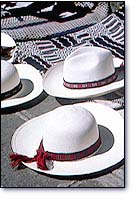
Panama hats are for sale in the Sasquisili marketplace. Photo credit: Anya Cristina. |
The Plaza Mayor, also known as Plaza de la Independencia -- because of the
monument erected in 1906 -- or simply as Plaza Grande, is the center of the life of the
city. The prison-like iron railings that once surrounded it have been removed and its
fountains have been replaced with flower beds and benches.
The conquistadors were instinctive urban planners. They first marked out a central
patio-like square around which they built a church, a governor's residence, an
archbishop's palace and a town hall and then drew up a street plan. On one side of the
Plaza Grande is the cathedral called the ``Cinderella of American Cathedrals'' in
comparison with those of Mexico or Lima.
Originally a modest wattle and daub construction that has been extended and
embellished since the 16th Century, its mid-19th Century coffered ceiling is a copy of
a Spanish Moorish original. The cathedral has wonderful flower-filled gilt altars on a
par with those of other Quito churches, ``whose insolent splendor,'' in the words of
Ecuadorian poet Jorge Enrique Adoum, ``overwhelms the visitor and contrasts with
the poverty of the faithful and the wretchedness of the beggars at their doors.''
Opposite the cathedral is the archbishop's palace. The governor's palace nearby is
equally neoclassical with a facade adorned with a massive Doric colonnade giving onto
the square. Guarding the wrought-iron entry gates are uniformed soldiers with large
guns by their sides. In the colonnade, uniformed schoolchildren, perhaps family
members, do their homework and chat with the soldiers. Inside, on each side of a
monumental staircase, is an enclosed patio with the sweep and drama of a movie set.
Inaugurated in 1830 when the Republic was proclaimed, the imposing governor's
palace was the last architectural project of the colonial power.
The major reason to visit Quito is to see the magnificent ``gold'' churches, named for
their richly gilded interiors and artworks. The most artistically important of these are
the Church of the Sagrario, La Compania de Jesus, and San Francisco, which house
paintings, sculptures and other gilded treasures of the celebrated Quito school, and
works by indigenous artists that compare with the work of Spanish painter Zurbaran.
The church of San Francisco and its adjoining convent occupy three hectares in the
center of Quito and have been dubbed ``an Escorial in the Andes,'' although their
construction pre-dated that of the Escorial in Spain -- barely 50 days after the
foundation of Quito by the Spaniards on Dec. 6, 1535. Around the church's
concentric semi-circular steps, incense, medallions, sacred images and decorated
candles are for sale, and on Good Friday a procession of hooded flagellants gather
here. The church of El Sagrario is noted for having the most magnificently carved inner
door in South America.
Also worth seeing is the church of Guapulo, a mix of neoclassic and baroque design
with massive twisted Moorish columns and altars overlaid with 24 caret gold leaf. It
has been estimated that 90 percent of the paintings and sculptures at the church of
Guapulo were made by Indian artisans, but the Spaniards would not let them sign their
work. The church is in Guapulo, the old district named after the Virgin of Guadalupe,
which is becoming the favorite neighborhood of Quito's young artistic set.
Situated between the old colonial city and the modern section of Quito is the 19-story
Hotel Hilton Colon. Originally the Hotel Colon, it re-opened in early 1997 after an
extensive remodeling as a link in the Hilton International chain, and offers all the
modern amenities including a spa, pool and full-service business center. The former
president of Ecuador, Abdala Bucaram, known as El Loco for his tall tales and belief
that he could fly, lived for one year in the presidential suite atop the hotel.
The elegant Swiss-run Hotel Oro Verde is a smaller, less business-oriented alternative,
but, alas, cannot boast a flying president in the penthouse.
The Hilton's Portofino Restaurant offers excellent Northern Italian cuisine, a lively and
urbane atmosphere and an excellent selection of Chilean wines, which are
extraordinarily good and inexpensive here. Another popular restaurant featuring
elegant French food is Rincon de Francia. The Hilton's casino is popular for late night
gambling, and Papillon is the happening disco with the young diplomatic set of the city.
Just in front of the Hilton Colon Quito is El Ejido Park where you can stroll to ``The
Cultural House'' (La Casa de la Cultura) and see artistic displays and crafts in gold,
filigree wrought iron, wood, wax and vegetable ivory that have been created by
Ecuadorian artisans since the Spanish Conquest. A few minutes away the Guayasamin
Museum features the contemporary work of Oswaldo Guayasamin, Ecuador's
internationally well-known artist.
Beware, however, the picturesque markets where fake native crafts, smuggled
watches, cigarette lighters, spectacles, cigarettes, chewing gum, razor blades and
contraband CD's are hawked. These markets in narrow alleys make easy pickings for
purse slashers who often work in teams to create a distraction and then attack.
Overall, the Ecuadorian people are gentle, soft-spoken and agreeably pleasant. Their
intense love of their capital city is reflected in the popular saying, ``On Earth Quito; in
heaven, a window to see Quito.''
INFORMATION:
Getting there: According to the excellent Lonely Planet guidebook, ``Ecuador and the
Galapagos Islands,'' taking an airplane is the best way to get to Quito, which has an
international airport with frequent direct connections to Houston, Los Angeles, Miami
and New York. Nearly all flights from Europe, Autralia and Asia go through these
American cities or through the Caribbean.
When to go: June, July and August are the months when Ecuador experiences the
most travelers.
Hotel rates: International luxury hotel rates begin, depending on the season, at about
$195 for a single room, and continue to about $290. But, remember that by staying in
less opulent surroundings you can cut prices by 50 percent or more.
Exchange rate: The currency of Ecuador, the sucre, is valued at about 4,530 sucres to
$1US.
(Susan Price is a travel writer in Aspen, Colo.)
© 1998, Susan Price. Distributed by Los Angeles Times Syndicate.