Over the rainbow
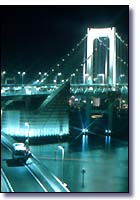
Ribbon of highway: The Rainbow Bridge. Photo: Barbara E. Thornbury |
By Barbara E. Thornbury, Los Angeles Times Syndicate, 06/98
In Tokyo, a gleaming futuristic cityscape is made for work and play.
TOKYO -- As an educator who specializes in Japanese literature and
culture, I could give you a long list of what fascinates me about
Tokyo. Recently I have added to it the city's newest work and play
land: the area municipal image makers have dubbed Rainbow Town.
Rainbow Town has nothing to do with Japan of the past. Rather, it's
a postmodern development that blasts away all traditional Japanese
images of Kabuki theater and folk festivals. In contrast, it offers a
fascinating, must-see view of Tokyo as it soars into the 21st century.
|
INFO:
To get to Rainbow Town from central Tokyo, take the Yurikamome line from the Yurikamome terminal next to Shinbashi rail station. One-way fares between stations range from $2 to $3, depending on the distance traveled.
Click here for more information. |
|
Officially known in Japanese as Rinkai Fukutoshin, which translates
as ``seaside sub-downtown,'' Rainbow Town sits on a parcel of man-made
real estate jutting into the waters of Tokyo Bay. It is 1,100 acres of
open space punctuated by high-tech offices, museums and restaurants
and a sliver of sand offering a knockout view of downtown Tokyo.
The best way to get to Rainbow Town is to start at Shinbashi train
station in central Tokyo. A few steps from the old station building is
the new terminal for the poetically named Yurikamome (the Gull), a
light rail line that loops through the Rainbow Town area. Buy a $6.50
day pass so you can get on and off the Gull without having to pay the
pricey individual fares between stations, and you are free to explore
the area unencumbered. (The train stop signs are in English, as well
as Japanese.)
I have never been on the Gull when it was not jammed. But even if
you do not get a seat, the ride from Shinbashi station across the bay,
which separates central Tokyo from Rainbow Town, takes only a few
minutes. Business people head to the half dozen or so office buildings
for work and appointments and to the exhibition building for the trade
shows.
But this is not just a sterile place of business. A few people have
bought condominiums in Rainbow Town and live there full time. Their
kids can even go to elementary and junior high school there.
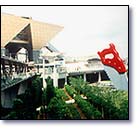
See saw: Tokyo Big Sight, the city's international exhibition center. Photo: Barbara E. Thornbury |
Day-trippers and tourists like me go to gawk at some of the
razzle-dazzle architecture, visit a museum or two, empty our wallets
in Tokyo Joypolis (a state-of-the-art virtual-reality game center) and
have lunch or dinner with a water view. The elegant Hotel Nikko Tokyo
offers accommodations with prices starting at about $250 for a double
room, not a bad price by Tokyo standards for that kind of hotel.
From central Tokyo, the Gull crosses the gleaming Rainbow Bridge, a
lovely bi-level structure that has already become one of the city's
icons. Teenage and 20ish trendsetters and trend followers such as
Yoko, the college-student daughter of one of my Tokyo friends, like to
gather up their buddies on weekend nights and head out across Rainbow
Bridge in their cars.
Often they head for Decks Tokyo Beach, which, despite its name, has
nothing to do with sand. This beach is a building housing restaurants,
boutiques and the Joypolis. There they grab a bite to eat, do a little
shopping and spend an hour or two playing fancy computer games. Just
being able to say they spent the evening in Tokyo's newest ``in'' spot
appears to be part of the allure.
Vast glass and steel edifices seem as much exercises in geometrical
fantasy as products of architectural design. Take Fuji Television's
new corporate headquarters, which opened last spring. One of Japan's
major broadcasting companies, Fuji Television has combined in one
linked complex the solidity of office towers with an open grid
arrangement in which a giant steel sphere has been set. I suppose the
sphere, whose floor space includes an observation area and restaurant
open to the public, is a symbol of the Earth. Or perhaps it is the
sun. A few hundred yards away is the Telecom Center office building, a
giant box with a cut-out center. Standing at a distance, you get the
dreamy impression that you are looking at a framed picture of the bay
and, if you gaze into the farthest distance, the Pacific Ocean.
In this neighborhood of abstract forms, the Museum of Maritime
Science is a standout, if only because it is built in the shape of a
giant cruise liner. An exhaustive (and exhausting) series of exhibits
cover in minute detail everything from water transportation to marine
development to water sports. On a visit last summer, I most enjoyed
the self-guided tour of the Soya Antarctic research vessel that is
anchored just outside the museum's main building. Until its
decommissioning 20 years ago, the Soya had traveled to Antarctica six
times to survey glaciers and various geological features.
Crewless and silent as the Soya is now, the self-guided tour that
threads its way though the ship's narrow and winding passageways and
in and out of its myriad chambers allows visitors to vividly imagine
what life aboard this Japanese expedition ship may have been like. It
is the little things that catch the eye: the books and musical
instruments carefully stowed away on shelves, the meticulously
detailed logs laid open for casual inspection. My romantic impression
was one of cramped, yet cozy efficiency mixed with adventure on the
icy seas.
The maritime museum, the Telecom Center and the Fuji Television
headquarters are among the buildings that have observation decks on
their upper floors, offering sweeping views of Tokyo's skyline and the
Pacific.
There are amusements at sea level too. A park called Odaiba Rinkai
Koen offers a sandy beach for sun worshipers and windsurfing
enthusiasts. It is also where the occasional beach volleyball
tournament is held.
Each time I have gone over to Rainbow Town I have taken the Gull as
far as the international exhibition center, which is the second to
last station on the line. From there I have made my way back in the
direction of Shinbashi station, getting off and on, as fancy dictates,
at Gull stops along the way.
Like everything else in Rainbow Town, the international exhibition
center has its own special name: Tokyo Big Sight. Outside, a giant
red-handled saw (yes, the kind that cuts wood) is the center's public
art showpiece. Inside, the halls and meeting rooms are the setting for
a frenetic schedule of world-class trade shows that are generally open
to anyone interested enough to pay an admission fee of about $10.
The International Food Products Industry Show, the Technopia
(computer) Show, the Auto Service Industry Show, the Asia Beauty
Industry Expo and the International Housewares Show are a sampling of
events last year. Such events are generally geared toward an
international clientele and would be fun even for those who don't
speak Japanese.
I was staggered by the sheer volume of people flowing along Big
Sight walkways, up and down escalators and through hallways, although
the structure is certainly large enough to accommodate masses. At some
point, the stream of people seemed to flow into Wanza Ariake Mall.
Only a stone's throw from Tokyo Big Sight, Wanza Ariake Mall
occupies two lower floors of an office and showroom complex called
Tokyo Fashion Town. Perhaps 20 eating places -- from sushi shops to
McDonald's -- do business here. There are also a few shops, including
a nice bookstore. The mall has its own indoor showplace in its airy
central concourse. In it, a silvery waterfall sprinkles down to a
ground-floor pool from a height of several stories.
But when it comes to playtime in Rainbow Town, the center of the
action is Decks Tokyo Beach. Its boutiques and 30 or so restaurants
are uniformly attractive and calculated to lure in hip, young crowds.
Looking for lunch? It's easy to spend 30 minutes or more shopping
through the five stories that house fancy shops, cute cafes and
handsome dining spots. An economic malaise is gripping Japan these
days, but you would never know it here. There is something oddly
reassuring about falling in with an obviously prosperous crowd
populated by young women toting Louis Vuitton bags and guys wearing
Ralph Lauren tennis shirts. Someone still has money to spend.
When your appetite for food has been sated, head to Tokyo Joypolis.
For an admission charge of $4 and between $4 and $6.50 for every game
played, another dimension of the post-modern world of Tokyo's Rainbow
Town can be experienced. Flashing lights and weird whooping noises
emanate from machines that are staging grounds for alien combat and
other tests of skill.
Although Rainbow Bridge and its Gull transportation system have yet
to celebrate their third birthdays, the land on which the development
sits has been decades in the making. A marvel of civil engineering,
Rainbow Town will doubtless see more buildings constructed on its open
spaces, once the Japanese economy returns to a firmer footing. It
promises to continue providing an interesting glimpse into Tokyo's
future.
INFORMATION:
Getting there: To get to Rainbow Town from central Tokyo, take the
Yurikamome line from the Yurikamome terminal next to Shinbashi rail
station. One-way fares between stations range from $2 to $3, depending
on the distance traveled. The $6.50 day pass is a sensible choice for
anyone planning to get off and on at several stations. The station
serving the Tokyo Big Sight international exhibition area is Kokusai
Tenjijo Seimon Eki. The Telecom Center has its own station (Terekomu
Sentaa Eki), as does the Museum of Maritime Science (Fune no Kagakukan
Eki).
For Hotel Nikko Tokyo (from the U.S., tel. 011-81-3-5500-5500 or
tel. 800-645-5687) and the Fuji Television building, use Daiba Eki
station. Decks Tokyo Beach is accessible from Odaiba Rinkai Koen Eki
station.
Museums: Admission to the Museum of Maritime Science (local tel.
5500-1111), open on weekdays from 10 a.m. until 5 p.m. (on weekends
and holidays until 6 p.m.), costs $8. (English guidebook available.)
The observation deck on the 21st floor of the Telecom Center is open
daily from 11 a.m. until 9 p.m. The entry fee is $4.80. The
observation floor in the Fuji Television building sphere is open to
the public without charge.
Also worth a visit is the Port of Tokyo Museum (tel.
5500-2587) on the 20th floor of the Aoumi Frontier Building. Open
every day except Mondays from 9:30 a.m. until 7:30 p.m., the museum
has displays related to Tokyo Bay and its reclaimed land projects.
Admission is under $2.
Ride the waves: Visitors who like boat rides may want to tour the
waters of Tokyo Bay and visit Rainbow Town by water bus (ITAL) (suijo
basu) (uqTAL). For more information: Japan National Tourist
Organization, 624 S. Grand Ave., Suite 1611, Los Angeles, Calif.
90017; tel. (213) 623-1952, fax (213) 623-6301.
(Barbara E. Thornbury is an associate professor of Japanese at
Temple University, Philadelphia, Pa.)
© 1998, Barbara E. Thornbury. Distributed by Los Angeles Times Syndicate