Renaissance on the river
By Carl Duncan, Los Angeles Times Syndicate, 06/98
In Hoi An, an ancient trading port regains its glory.
The riverside market, on the wharf along Bach Dang Street, is pure
traditional Vietnam. Women in loose pantaloons and conical straw hats
squat next to bamboo baskets displaying all manner of colorful
produce.
|
INFO:
Getting there: Vietnam Airlines flies from Ho Chi Minh City to Da
Nang, starting at $260. Where to stay: Hoi An Hotel, 6 Tran Hung Dao St.; tel. (011) 84 51 861 373. Doubles from about $34.
Click here for more information. |
|
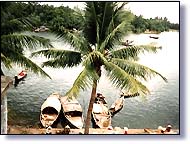
Latecomers from nearby hamlets approach the quay in narrow sampans,
gracefully dipping their quill-shaped oars. Others from outer islands
arrive in larger boats, stacked with produce and bicycles. The market
becomes a bobbing sea of hats.
But the bustle has a distinct small town, neighborly feel. One
friend offers another some flowers. Vendors chat and laugh among
themselves, even play a hand of cards. More than once my travel
partner Maria and I see a departing boat, its diesel quietly ticking
under hand-hewn decks, swing back around to pick up someone waving
good-naturedly from the wharf.
Hoi An sits on the north bank of the Thu Bon River on Vietnam's
central coast, just south of Da Nang. The shallow Doi estuary and
offshore islands protect it from storms off the South China Sea.
Away from the highway and out of the mainstream, Hoi An retains its
traditional trading port character, intact from the days when the
Vietnamese first opened their world to foreigners. There are over 800
historically significant structures in the city, but Hoi An is not
just beautiful buildings; it's a community of people. Some of the
families here have been neighbors for over 400 years. Vietnam tourist
publications refer to the old town section as ``a living museum.''
As Vietnam liberalizes its trade and tourism industries, Hoi An is
regaining the glow of its golden years. Owners of lovely 17th and 18th
Century houses are opening restaurants and small hotels. Artists,
finding both inspiring images and a steady market, have opened
galleries.
The visitor to Hoi An today will find all the amenities he or she
needs, as well as a cultural authenticity and a sincere welcome that
seem from another age.
``Hoi An is nearly perfect because the war never got here,'' said
Tang Thu, who owns an art gallery in the old town. ``Up in Da Nang,
everything was bombed and broken.''
It was only a $15 taxi fare from the airport in Da Nang to Hoi An.
However, the potholed road turned the 20 miles into a dusty hour's
drive. Appropriately enough, the pavement smoothed out at the Hoi An
signpost.
For a town of 75,000, Hoi An has a surprisingly small, quiet feel.
We got out at the end of Le Loi Street, four blocks from the
waterfront. No cars are allowed in the old riverside section.
We peered into a couple of small hotels within a few feet of each
other and settled on the Thuy Duong. One hundred dollars got us a week
in their choicest upstairs corner room. It was spacious and spotless,
with a modern bath and mahogany furniture. Though it had an air
conditioner, the February weather was too delightful. We opened the
casement windows, headed downstairs, and, ravenously hungry, sauntered
down Le Loi to the waterfront.
Silk and cotton tailors line the street, along with antique shops,
art galleries, historic homes and garden courtyards behind low gabled
walls. The tiles of the roofs, green with moss, overlap and connect
with those of their neighbors. Many of the old stucco walls, stained
with algae and draped in bougainvillea, are painted in pastels. Hoi An
is alive in tropical colors.
Thanh Restaurant, lemon yellow and framed with flowers, sits a few
feet off the quay. Like all its neighbors, the building is centuries
old. Lacquered pillars support round beams, hardwood strapping and
heavy tiles. Our carved hardwood table faced the waterfront. Gentle
Vietnamese music played from somewhere.
No cars. No roaring motorcycles. No pedicabs. Only slippered feet,
conical hats and bicycles. No yachts or fiberglass boats in the
harbor. Only sampans, small and not so small. Nothing spoiled that
delicious sensation of sitting comfortably ensconced on the far side
of the world, in a simpler, slower century.
Prices on the menu (written in English, French and Vietnamese) were
from another era also. The most expensive item was $3. Most were under
$1.50.
Hoi An's cuisine is a blend of the stir-fry and noodles of the
north and the spicier dishes of the south. We ordered a crepe filled
with shredded duck, shrimp and spices; rice paper-wrapped shrimp
spring rolls with chile-spiced peanut sauce; stir-fried vegetables.
And two bowls of (ITAL) cao lau (uqTAL).
A Hoi An specialty, (ITAL) cao lau (uqTAL) is a steaming bowl of
flat, yellow noodles in a broth flavored with cilantro, ginger, anise,
basil and mint. It has crisp bean sprouts and croutons and is topped
with slices of pork or, optionally, chicken or duck. Served with
edible rice paper, it's a delightful dish any time of day. With two
large BGI (``beegee'') beers, a good brew from Da Nang, the bill was
just $8.50.
Hoi An is such a small place, a map is hardly necessary. One good
idea, however, is the $5 Old Town Ticket (available at the tourist
office at the Hoi An Hotel). Proceeds help to preserve the town's
historic structures. The ticket gets you into a selection of museums,
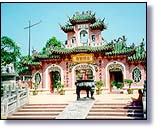
Chinese assembly halls, wealthy merchant houses and the 1653 Quang
Cong Temple, one of 20 Chinese temples in Hoi An.
Up from the riverside market, past the silk and cotton tailors and
through the bamboo merchants, is the Museum of History and Culture.
Amid artifacts, maps and archive photos -- all with English
explanations -- Hoi An's colorful past becomes obvious.
Between the second and 10th Centuries, Hoi An was the principal
port of the seafaring Champa kingdom, a once-powerful society that
embraced Indian culture and celebrated it through sculpture. Champa,
encompassing most of southern Vietnam, survived for more than 1,000
years, withstanding attacks by the Chinese, Vietnamese, Khmers and
Mongols.
In the 15th Century, the Vietnamese from the north pushed the
Champas south and opened the port to foreign traders.
Japanese, Chinese and Portuguese merchants had permanent
settlements here by the early 1500s. When the Ming Dynasty was
overthrown in 1644, many Chinese mandarins expatriated to Hoi An. They
built beautiful assembly halls and harborside homes. For the next 200
years, Hoi An (then known as Faifo) flourished.
Prosperous merchants built shops, bridges and temples. Mixing
Chinese, Japanese and Portuguese elements, they created Hoi An's
unique architectural style. In a land of bamboo and thatch, they built
permanently with brick, tile and hardwood.
During the 17th and 18th Centuries, this was the most important
port in southern Vietnam. Giant four-masted junks and majestic square
riggers plying the China-India trade route regularly called at Hoi An.
They anchored, sometimes for months, waiting for the monsoons to shift
homeward again.
When the harbor silted up in the 1800s, a new port was built on the
Han River at Da Nang. Time came to a halt in Hoi An, and the world
passed it by.
There's much more to see in Hoi An than the government-run entries
on the $5 ticket. Some residents of the privately restored houses
invite you in for a tour and then let you browse their curio shops.
Everywhere, we found people with a surprisingly innocent sense of
hospitality.
The hand-crafted goods that Hoi An was famous for in her glory days
-- cottons, silks, ceramics and fine carpentry -- are still made and
sold here.
Nearly every shop we passed had Hoi An ceramics.
Characteristically, these are white with cobalt blue designs. We
couldn't resist one of the commonly seen duck-shaped tea pots ($5).
Antique shops also offer authentic 17th and 18th Century Hoi An
ceramics, often found preserved in the silt of the harbor.
For a small tropical port that seems to live in a time capsule, the
business level can be quite sophisticated.
Kim Bong Traditional Carpentry (108 Nguyen Thai Hoc St.) makes
lovely hardwood boxes, furniture and cabinets. A matching set of
carved mahogany furniture (chair, $200; couch, $250; and table, $200)
looked tempting. But it was heavy, barely movable. How would you get
it home?
The saleswoman, statuesque in long black braids and a white
long-paneled traditional blouse, answered without hesitation. ``It
will cost $146 to truck to Saigon and clear customs. And $120 to ship
across the Pacific. We take care of everything. It takes 30 days to
the West Coast.''
Only a block away, Hoi An's famous covered Japanese Bridge spans a
small canal. Dating from 1593, the wood-and-stone bridge connects the
old Japanese and Chinese trading communities. Hoang Diep owns a house
and silk shop next to the bridge.
We browsed his display of kimonos ($14), scarves ($5) and blouses
($7). All were in soft silk and hand-painted with flower or bamboo
designs. Diep had an interesting sort of look to him and, as Maria
shopped, I struck up a conversation. He was once a journalist, he
said. And because of his political views spent 13 years in prison
between 1975 and 1988. The government at the time confiscated his
house.
``When I got out, I sought refugee status in many countries,
including Australia and the U.S. But no one accepted me.''
In 1991, as a result of Vietnam's liberalizing government reforms,
his old Hoi An house was returned.
One morning our hotel receptionist greeted us with a warning.
``There will be many, many tourists in town today.'' True enough, 14
minibuses and one luxury coach arrived with about 450 video-toting
Belgians.
They were passengers on the cruise ship (ITAL) Calypso (uqTAL),
anchored in Da Nang for the day. The seaport of Hoi An was a
much-anticipated stop on their two-week itinerary from Hong Kong to
Singapore. After a few hours in Hoi An, they were off to see the ruins
of My Son.
The original sacred capital of the Champas until 980 A.D., My Son
sits in a hollow of green hills up the Thu Bon River, an hour's drive
west of Hoi An. Footpaths through pasture and forest connect about two
dozen brick towers in varying stages of preservation.
Typically Indian in structure, the towers are unique
for what was put inside. Pedestal altars adorned with reliefs once
supported free-standing stone statues, some of them life size.
(Examples of these can be seen in the Cham Museum in Da Nang.)
Tourists have fueled Hoi An's latest trade commodity: art.
On Tran Phu Street, which runs through the heart of the old town,
oil paintings seem to spill out of half of the historic houses along
the street. Tang Ngoc Thu opened his art gallery at 109 Tran Phu three
years ago. According to his count, Hoi An now has 35 art galleries and
15 single-artist shops.
``Artists are attracted to Hoi An,'' Thu told us, ``because they
want to paint traditional scenes. Hoi An not only has historic urban
scenery, but a beautiful rural countryside, too. And now it's a good
market.''
Stiff competition keeps prices uniformly low. Charcoal sketches on
rice paper cost only $3 to $4. Oils on silk (16x22 inches) are $25 to
$30. We recognized the familiar Hoi An hallmarks: pastel houses
stained with algae, sagging tile roofs, sampans along the waterfront,
(ITAL) cao lau (uqTAL) vendors with their bamboo carriers. The
dominant style appeared whimsical, colorful, bold.
On our last day, we had an early dinner at the floating restaurant,
Han Huyen, not far from the Japanese Bridge. The sights and sounds at
our elbows were straight out of an IMAX theater. A fisherman sat on
the bow of his tiny sampan, trailing a net while paddling with his
bare foot. On the foot bridge above him, which crosses the river to a
carpenters' hamlet, children laughed as a baby water buffalo trundled
across, lowing for its mother.
While I enjoyed noodles and beef, Maria gamely sampled the (ITAL)
chao tom (uqTAL), spicy ground shrimp wrapped around stalks of sugar
cane and grilled. It burnt her tongue until she had tears in her eyes.
The waitress hurried over.
``So sorry!'' she exclaimed, and rushed off for a glass of cold
water.
``Interesting place, is it not?'' The cultured voice had only a
touch of German accent. At the table next to ours, Heinrich and his
wife, Brigitte, introduced themselves. He was a geology professor and
one-time Fulbright scholar. She was sunburnt from exploring Champas
ruins on a nearby island. Both were engagingly outgoing, in their 60s.
``People often ask us why we travel so much,'' Heinrich said with a
laugh. ``Well, it's not for escape. It's so we can wake each day to
something new and interesting.''
Brigitte gestured toward the waterfront. ``A good place,'' she
added, ``is where you can stay a week and not be bored.''
INFORMATION:
When to go: Central Vietnam has two seasons, wet (May to Nov.) and
dry (Dec. to April). The temperature is pleasant all year round, with
March and April the warmest months. Jan. to April are the busiest
months.
Getting there: Vietnam Airlines flies from Ho Chi Minh City to Da
Nang. Round-trip fares start at $260.
Where to stay: Hoi An Hotel, 6 Tran Hung Dao St.; tel. (011) 84 51
861 373; fax, (011) 84 51 861 636. It has 100 rooms, pool and
satellite TV. Doubles from about $34.
Thuy Duong I Hotel, 11 Le Loi St.; tel. (011) 84 51 861 574; fax
(011) 84 51 861 330. Doubles $10 to $15.
Huy Hoang Mini Hotel, 73 Phan Boi Chau St.; tel. (011) 64 51 862
211. Restaurant/bar on the river. Assorted quality rooms from $10 to
$35.
Vinh Hung Private Mini Hotel, 143 Tran Phu St.; tel. (011) 84 51
861 621; fax (011) 84 51 861 893. Lovely old wooden Hoi An house
recently converted to a small hotel. Reserve either room 206 or 208
($40 and $45); like a movie set with antique beds, rattan couches,
traditional balconies.
(Carl Duncan is a writer and photographer in British Columbia, Canada.)
© 1998, Carl Duncan. Distributed by Los Angeles Times Syndicate.