Eco-luxe in Belize
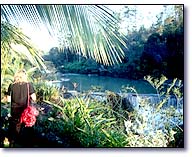
First-class flora as viewed from Kitty's Place. Photo credit: Michael Parrish. |
By Michael Parrish, Los Angeles Times Syndicate, 5/98
Comfortable jungle lodges are giving nature lovers another reason to
visit this Central American country.
TOLEDO DISTRICT, Belize -- ``It's a mystery to me why they're so
friendly in here,'' says Ray Harberd as half a dozen big, iridescent
Blue Morpho butterflies flap around his head, land briefly on his
shoulder, then settle back among slowly quivering clumps of cousins
resting just an inch under his hand.
|
INFO:
When to go: Dry season normally runs Feb. through June, with May
being the driest. But the rainy season can be fine, with only a shower
or two daily, and lots of flowers.
Tourist info: Consulate General of Belize, 5825 Sunset
Blvd., Suite 206, Hollywood, Calif. 90028; tel. (213) 469-7343. Also: Belize Tourist Board, 83 N. Front St., P.O. Box 325, Belize City,
Belize; tel. (800) 624-0686 or 011- 501-2-77213.
Click here for more information. |
|
In the wild, they are as skittish as tropical fish, as I remember
from my last visit -- almost 30 years ago -- to this rain forest in
Central America's only English-speaking nation.
It's January and we're on a lush jungle hillside near Belize's
southern tip, in a one-story concrete building with netting for
windows. It's the breeding facility, where caterpillars are reared in
small round boxes and butterflies brush by. Harberd is giving the
personal tour that he furnishes all visitors to Fallen Stones
Butterfly Ranch and Jungle Lodge.
My friend and traveling companion, Kristin White, and I have come
to Belize to be afoot in the jungle, to take stock of the exotic
plants and animals that flourish in this small country facing the
Caribbean just below Mexico's Yucatan Peninsula. It also turns out
that Kris has a thing about caves, and in a limestone-rich land, they
are plentiful. I'm also interested in seeing some of the newer
ecological resorts known locally as jungle lodges, many of them far
more comfortable than the basic lodgings of 30 years ago.
We plan to travel quite a lot using public transportation, mostly
sturdy former U.S. school buses. They're perfectly safe and run on
schedule, but you can't take one, for example, through the jungle to
see Mayan ruins. Next visit, we're already planning to have a rental
car lined up at Belize City's Philip Goldson International Airport.
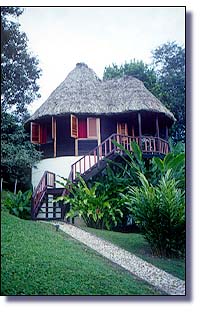
Curvaceous: A Chaa Creek cottage. Photo credit: Michael Parrish. |
Eco-tourism has exploded worldwide, but few countries offer the
opulent natural resources of Belize, the former British Honduras. For
U.S. visitors, there's the added advantage of familiar languages --
English and, almost everywhere, Spanish -- as well as right-hand
driving on generally decent roads, a stable government, unusual racial
harmony, conveniently exchanged currency and a pretty high degree of
personal safety.
Belize isn't cheap. The country has a fairly high living standard,
and it instituted an unpopular 15 percent value-added tax two years
ago, causing some tour operators to head for other countries. But this
means less crowded sightseeing. Belize's total population of 200,000
is scattered over a country the size of Massachusetts.
The country's flora and fauna, the caves, Mayan ruins, rivers, cays
(pronounced ``keys''), jungle and pine forest exist on a grand scale,
however. There are wild orchids, hibiscus, 15 varieties of
hummingbirds, black and spotted jaguar, tapirs, toucans and 500 other
bird species, howler monkeys, manatees, iguanas, storks, coatimundis
and -- along the world's second-longest barrier reef after Australia's
-- a great aquarium of sea creatures.
Be warned: There isn't a golf course in the country. Most of Belize
hits the sack around 9 p.m., particularly in the jungle lodges. Biting
flies, mosquitoes and humidity must be contended with. And even the
well-named Belize First magazine admits that fancy dining is hard to
find. But we eco-tourists haven't come to Belize searching for
five-star restaurants.
Our first stop is Punta Gorda, in the extreme south, a drowsy
little border burg that is mostly Garifuna -- also known as the Black
Caribs -- a people descended from Africans and South American Indians.
Here we find a good local guide (through Grace's restaurant in Punta
Gorda), who steers us in his Isuzu Trooper over 15 miles of paved
highway, then 22 miles of rough dirt track, to the butterfly ranch.
In the rain forest around Punta Gorda, the wettest and most
luxuriant in the country, are the Kekchi Mayan villages of San Antonio
and San Pedro Colombia (the Toledo Ecotourism Assn., in Punta Gorda,
can arrange overnight stays with village families). There's also Blue
Creek Cave and Mayan ruins, including Nim Li Punit, Uxbenka and
Lubaantun, which was a significant ceremonial and business center
dating from about A.D. 700 to 900.
On the way to the ranch, we stop at Lubaantun (``the place of
fallen stones,'' in one Maya dialect). Santiago Coc, son of a Kekchi
mother and Mopan Maya father, is the guide and caretaker of the site
for the Belize Department of Archeology, and he gives a knowledgeable
tour of the grounds as part of his job (though he'll accept, and
deserves, a tip at the end).
Though much meticulously placed rock work can be seen, the pyramids
and ball courts have been only partially excavated. Several areas are
jumbles of building stone.
The 42-acre butterfly ranch is on a sensational spot, the highest
point for five miles around, with lofty views above the Maya Mountains
Forest Reserve.
Two years ago, Harberd opened a jungle lodge on top of the hill,
built and staffed by locals from the Mayan villages. The comfortable,
secluded, thatch-roofed cabins, fully bug-screened and with hot-water
showers, have porches with private views of the rain forest canopy
below. The lodge can handle 18 to 22 people at a time. The dining room
and separate lounge and bar are showplaces for local woods.
That night, our chef, a courteous but not entirely shy young Mayan
woman, comes out after dinner to ensure that we liked our beef in
yogurt sauce, potatoes Anna, feta cheese salad, vegetable soup, bread
baked on the premises and lemon mousse with cream, all delicious.
Our next stop is the beach at the curious town of Placencia, less
than 100 miles from Fallen Stones, a couple of hours on the local bus
that we took. In Placencia, the main street is a sidewalk, about two
feet wide, that runs along the sand between restaurants, saloons, gift
shops and small hotels.
This is a T-shirt and shorts sort of place. We spend a particularly
pleasant evening in conversation with visiting international tourists
and Belizeans at the Cozy Corner Beach Bar and Restaurant, though
there are good places to eat and drink, and to stay up late elsewhere
in the small town.
We stay that night at Kitty's Place, by most accounts the best and
most interesting lodging, though it's a 1 1/2-mile hike down the road
from town center. (Kitty rents bicycles.) Kitty Fox, formerly of
Colorado, has reigned over the clean cabanas and picturesque,
colonial-style restaurant and bar for the past decade. Fox also offers
skin-diving expeditions, tours of nearby cays, tours down the Monkey
River and about anything else legal that you want to do.
For our purposes, Placencia is close to the Cockscomb Basin
Wildlife Sanctuary, the jaguar preserve. Kitty's, as well as the
Pelican Beach Resort, in Dangriga, can get you there, too, either by
yourself or sharing transport and guide fees with other visitors. It's
a ways off the main road, so plan to spend a day. Better yet, arrange
with the Belize Audubon Society to stay overnight in the simple
dormitories in the sanctuary. Don't let your hopes soar too high about
seeing the nocturnal, and very smart, jaguar, however. One Placencia
resident we ran into thinks she saw about four inches of a jaguar tail
one night.
``You've got no chance of seeing a jaguar by day,'' Kitty says
flatly. ``Maybe paw prints if you stay overnight at the Audubon
dorms.'' What you're more likely to see trotting by at night is the
Baird's tapir -- known locally as the mountain cow -- a nonthreatening
relative of the horse that can weigh in at 600 pounds, or any of
hundreds of tropical plants and animals.
Doubting that we would have time to make the necessary arrangements
with the Audubon Society, which is based in Belize City, we head to
the alluring beach -- and the sand flies -- for which we were
unprepared.
No matter what you're told about bugs, slather on the repellent
early and often.
We move on. The entire country is geared to nature-loving, but if
there's a white hot center of eco-tourism, it's the Cayo District in
western Belize. We get there, traveling overland along the
occasionally bone-jarring but charming Hummingbird Highway. To fly
from Placencia to Belize City, then out west, would have taken about
the same time as the bus trip -- five hours, if you count waiting
around at airstrips. And we would have missed the region's absurdly
green hills and valleys, the tiny villages (Steadfast Community, Silk
Grass Village), the old one-lane bridges, the Belly Full Inn
restaurant, orange groves and bright-colored Caribbean-style houses
along the way.
At Georgeville, on the outskirts of San Ignacio, we happen upon a
local guide who takes us up into the Mountain Pine Ridge Forest
Reserve, to Blancaneaux Lodge, the old hunting resort bought in 1981
and remade by movie maker Francis Ford Coppola. We arrange with the
guide to show us around when we return the next day.
A half-a-dozen high-end lodges are scattered around the Cayo
District, and most any of them would make good bases from which to see
the district's profusion of rivers, caves, falls, bathing pools, ruins
and nature trails. The Five Sisters Lodge faces a dramatic expanse of
low waterfalls and river pools: ergo five sisters.
Chaa Creek Cottages, one of the better known jungle lodges, is a
big, open place on the Macal River, with 20 thatched cottages and 300
privately held acres. It offers a varied menu of ecologically oriented
activities and is next door to Ix Chel Farm, a research facility that
offers tours of its Rain Forest Medicine Trail. The trail is a
showcase for traditional plants used in healing by Belize's last Mayan
shaman, who died in 1996 at age 103.
But Blancaneaux has something else: style. The grounds are
manicured, from the gateway to the stone-and-concrete parking lot to
the croquet field and the lodge buildings themselves. Not a leaf falls
that isn't picked up, as Kris notes with an upturned eyebrow.
The rooms and public spaces are rich with local
hardwoods, stone and art -- much of the art from nearby Guatemala --
and the buildings were designed by Mexican architect Manolo Mestre.
It's also the first place we stay that has real reading lights over
the beds. We ran into only one other couple staying as guests. But
even if the place were packed, the luxurious spaces would still have a
sense of privacy. I liked the classiness of the rooms and grounds, a
haven to return to after a day in the caves or on dusty trails. It
would be a great place, frankly, for a love affair or honeymoon.
On closer inspection, the pool and falls are largely created by
concrete, though in an eco-sensitive cause. Water pressure from the
small dam drives the lodge's electric generator, hidden downstream.
The lodge is situated in a pine forest, not jungle, and the humidity
isn't as apparent as elsewhere in Belize.
We have drinks, then dinner in the Jaguar Bar, which could easily
make a movie set: essence of tropical hotel. Kris doesn't much care
for her pizza, despite its Italian breeding. I devour a tasty pork
(ITAL) braciola (uqTAL) while we are oriented by a loquacious
bartender. I sleep like an overstuffed tapir.
Several hummingbirds and I have a cup of coffee on the deck the
next morning, then Kris and I meet our guide. The lodge keeps horses
for trail-riding through the forest. And there's great swimming among
the pools and waterfalls nearby. But this morning we push on for the
Rio On and its famous pools.
This is what people rightly term paradise. As the Rio On ambles
down a hillside into the forest, rocks form a randomly staggered set
of private pools. No other soul is in sight this day. A short drive
away, Kris finally gets inside a cave, and a spectacular one at that.
The vaulting, double-mouthed Rio Frio Cave, with the Rio Frio running
through it, is another ancient site of Mayan ceremonies.
Now, trees around the entranceway are labeled for visitors. And
concrete and stone steps help one to safely navigate the cave. The
ceremonies of a thousand years ago must be left to the imagination.
INFORMATION:
Basics: A good half-dozen car rental agencies have offices at the
airport, Belize International; reservations are recommended.
When to go: Dry season normally runs Feb. through June, with May
being the driest. But the rainy season can be fine, with only a shower
or two daily, and lots of flowers.
Where to stay: Punta Gorda: The Hotel Pallavi (19 Main St., Punta
Gorda, Belize, C.A.; tel. 011-501-7-22414) is clean, relatively new
but very basic, with Grace Coleman's tidy cafe next door. Rates: $14
double.
Fallen Stones Butterfly Ranch and Jungle Lodge (P.O. Box 23, Punta
Gorda, Belize, C.A.; tel./fax 011-501-7-22167) or book through the
U.S.-based travel agency Close Encounters; tel. (888) 875-1822.
Cabanas, doubles: $100; breakfast $7.50, lunch $12.50, dinner $22.50.
Placencia: Kitty's Place (Placencia, Belize, C.A.; tel.
011-501-6-23227, fax 011-501-6-23226). Cabanas, doubles, on the beach:
$155.
Cayo District: Blancaneaux Lodge (Central Farm, P.O. Box B, Cayo
District, Belize, C.A.; tel. 800-746-3743 or 011-501-9-23878, fax
011-501-9-23919). Cabanas, doubles: $160; breakfast about $6, lunch
about $7, dinner about $20.
Five Sisters Falls & Lodge (Mountain Pine Ridge Forest Preserve,
Belize, C.A.; tel./fax 011-501-91-2005). Private cabanas, doubles:
$95; breakfast $6, packed lunch $5, lunch $7.50, dinner $15).
Chaa Creek Cottages (P.O. Box 53, San Ignacio, Cayo, Belize; tel.
011-501-9-22037, fax 011-501-9-22501). Double, cottage: $130;
breakfast $8, packed lunch $7, lunch $10, dinner $22.
For more information: Consulate General of Belize, 5825 Sunset
Blvd., Suite 206, Hollywood, Calif. 90028; tel. (213) 469-7343, fax
(213) 469-7346.
Belize Tourist Board, 83 N. Front St., P.O. Box 325, Belize City,
Belize; tel. (800) 624-0686 or 011-501-2-77213, fax 011-501-2-77490
Pests: Belize has serious bugs. We took a repellent with 28.5
percent DEET, and it didn't even slow the sand flies. Next time we'd
take Jungle Juice, which damages plastic sunglasses and watch crystals
and can't be constantly worn, but is 95 percent DEET.
There are some serious, dangerous snakes, though you won't likely
encounter one. The fer-de-lance or, locally, yellow jaw (for the
yellow streak under its head) can be long, very poisonous and fast.
But the jumping tommygoff, a short, thick viper is my favorite.
Many Belizeans call any snake a tommygoff, but the real thing, most
believe, can jump 2 feet, and backward, when it strikes. Snake experts
say that's exaggerated. Yet they agree that it's so powerful and fast
that it can twist and strike in a way that looks like it's jumping.
The basic precaution: As in U.S. rattlesnake country, don't put hand,
head or foot anywhere that you can't see. Many snake bites, for
instance, occur when people step over a log without looking at the
other side first, or stick their hand under a porch step -- startling
a snake.
Guides: Hire only legal, licensed guides since they're most likely
to give you accurate information about the plants, animals and
history. They're expensive, but I'd at least hire a guide for the
first day or two, just to get oriented. When making the deal, be clear
whether you're quoting U.S. or Belizean dollars (BZ), which are worth
half the U.S. dollar, and whether the 15 percent value-added tax (VAT)
and gratuity are included.
In the jungle, stay on the path. Even locals do.
(Michael Parrish, a free-lance writer, is a former business
reporter for the Los Angeles Times.)
(c) 1998, Michael Parrish. Distributed by Los Angeles Times
Syndicate.