Journey to the geographical center of Europe
By Lucy Barajikian, Los Angeles Times Syndicate, 5/98
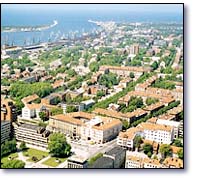
Klaipeda, Lithuania's busiest port. (Photo courtesy Randburg.com) |
Adventures and misadventures abound when a small army of 600 cruise
passengers spread out in all directions to see the sights in Lithuania
five years after its independence.
We didn't know it at the time, but when we visited Lithuania
several years ago, we were in the geographical center of Europe.
Surprised? So were we. But nobody was more surprised than the
Lithuanians themselves when the National Geographical Institute of
Paris in 1989 announced that by drawing a series of concentric circles
over a map of Europe, it discovered that the geographical center of
Europe was 15 miles north of Vilnius, Lithuania's capital. That's
quite a distinction for a small Baltic state.
|
INFO:
When to go: June, July, August.
How to go: Planes fly from most European capitals into Palanga.
From there, buses can take you into Klaipeda. Ferries link Klaipeda to the German cities of Kiel and Muhkran. Klaipeda is also accessible by bus or train from Belarus, Estonia,
Latvia, Poland and Russia.
For more information: "Klaipeda
in Your Pocket" is available from the Lithuanian
Tourist Office, 2622 16th St. N.W., Washington, D.C. 20009. Tel. (202)
234-5860.
|
|
At the time of our trip, we were sailing from Hamburg to St.
Petersburg along the Baltic Sea, and on our way back had anchored at
Klaipeda to visit Lithuania's busiest port. All along the way, from
Oslo to St. Petersburg, we had seen magnificent cultural treasures,
but we were uncertain what this small Baltic state, bordered by Latvia
and Poland, could offer curious travelers, despite its special
geographical status.
Now, strolling through Klaipeda's open-air Mazvydas Sculpture Park,
we were hoping to capture the ultimate Klaipeda Kodak moment. Most of
the massive granite and bronze abstract sculptures we saw were
sculpted in the heavy style of the Stalinist period, and looked like
they were in need of a major beauty fix. What mystified us most were
several works that resembled slightly twisted spikes protruding from
the centers of large pedestals, and we wondered: Was this some cryptic
Lithuanian national symbol or some new art form celebrating their
freedom from Russian occupation?
``Neither,'' explained the local guide a bit sheepishly. ``The park
isn't fenced in, and sometimes people come in and steal the bronze
sculptures right off their bases and sell them for scrap metal.''
These metal spikes graphically illustrate the consequences of
Lithuania's political and economic upheavals. During World War II,
Klaipeda experienced the barbarisms of war when it was occupied by
Germany. There was even greater devastation when the Red Army stormed
into the country in 1945 and rained misery on Klaipeda. It closed its
borders to foreigners, imposed severe economic sanctions, and reduced
most of the city to rubble.
In 1990, it was Lithuania that took the lead among the Baltic
nations to break free. Our cruise came just a brief five years after
Lenin's statue in Klaipeda was toppled and the country had declared
its independence from half a century of Soviet domination. Even today,
the scars run deep. Since independence, the people have been trying to
rebuild facilities and are seeking ways to strengthen their economy,
but many are still struggling to survive in any way they can.
That's when we came on the scene -- some 600 passengers strong --
from one of the first cruise ships to enter Klaipeda's waters. The big
question was: Was the city ready for us or would we terrorize the
local population with our visit? As it turned out, our tour was the
adventure of a lifetime, memorable for all the right reasons -- and
also for some of the wrong reasons.
Klaipeda is Lithuania's third largest city and quite cosmopolitan
in character with a growing number of discos, cozy cafes and elegant
restaurants. It is the main city on the coast at the mouth of the
narrow strait that links the Courland Lagoon (also known as Kuronian
Lagoon and called Kursiu Nerija in Lithuanian) to the Baltic Sea on
the eastern side. The narrow, one-mile-wide Kursiu Spit extends like a
dangling rope for some 60 miles from Klaipeda to its most southernmost
city, Nida, into the border city of Kaliningrad in Russia.
Our itinerary included visiting Old Town on the mainland which, in
1969, was designated a cultural monument, and also touring the sights
along the Spit. This magnificent area is known as the Lithuanian
Sahara because it boasts the highest sand dunes in Europe, some more
than 200-feet high. At the tip of the Spit is the home of German
writer Thomas Mann, who spent his summer holidays here between 1929
and 1932, and where he wrote ``Joseph and His Brothers.'' Also high on
our must-see list was Witches' Hill, where some 100 wooden fabled
figures, such as the pagan gods Perkunas and Neringa, carved by local
artists, are displayed.
Since more people had signed up for the land tour than anticipated,
the locals scoured the city for every available mode of transport, and
commandeered taxis and vans when they ran out of buses.
We unsuspecting tourists waltzed down the gangplank and boarded the
buses only to discover this would be a trip like no other, for when we
plunked down into our seats, some of us just kept right on going until
we were completely horizontal. The mechanism that adjusted the backs
of the seats didn't seem to be working. As a result, people were
sitting at different angles all over the bus.
To fully appreciate the scene, here's what happened when a couple
from Great Britain took the seats in front of us. The wife sat bolt
upright because the back of her seat wouldn't move at all. When her
husband, a proper, unflappable British gentleman sat down and leaned
back, he ended up with his head in my lap because the lever that held
his seat upright wasn't working at all. Without losing a beat, he
managed to introduce himself and his wife, apologized for the odd
juxtaposition, hoped it wouldn't inconvenience me, and began talking
about the glorious weather.
We were also getting more fresh air than intended through a large
hole in the middle of the aisle. Our ship's escort assumed a position
he hadn't anticipated when he decided he'd better straddle the hole
and remain standing throughout the trip to prevent passengers from
vanishing completely from view like Alice in Wonderland.
Actually, we were luckier than most. When the local guide on
another bus used the microphone to greet the passengers, the bus doors
flew open and wouldn't shut until she stopped talking. The Baltic
solution? Stop the bus. Talk. Stop talking. Drive. When the novelty of
this palled, the guide simply abandoned the microphone, stood in the
middle of the bus and shouted.
Honest, I'm not making any of this stuff up.
Our tour began in Old Town, which was established in the 15th and
16th Centuries on the left bank of the Dane River. Evidence of the
craftsmen and merchants who had labored in the area can be seen from
the street names -- Baker Street, Butcher Street, Locksmith Street,
and others, indicating the occupations pursued in each area. There's
an eclectic mix of styles and eras: cobblestone streets dating from
the 15th Century; warehouses and half-timbered buildings from the
Germanic 18th and 19th Centuries. There's the red brick, neo-gothic
post office, and even the remains of an old citadel and castle, with
ramparts and towers and other medieval defenses.
Just off Market Street is charming Theater Square where an 1857
reconstructed theater stands, modeled on the one that was built in
1819 but which later burned down. A statue and fountain commemorate a
local poet who lived in 1605. Most historic of all is the Klaipeda
Theater for two reasons. It is notable because the theater was one of
Richard Wagner's favorite haunts, but it is notorious as well, for it
was from its balcony in 1939 that Hitler personally addressed the city
to proclaim its incorporation into the German Reich. Also in the area
are several interesting museums, among them the Blacksmith Museum with
its display of elaborate grave memorials in intricate wrought iron,
and the Clock Museum with clocks that range from the earliest candle
clock to some magnificent 17th and 18th Century examples.
What we had not expected was the abundance of so-called
``Lithuanian gold'' that we saw wherever we went. This is the land
described by the ancient Greek poet Homer as the Amber Coast, and it
has supplied this precious commodity from time immemorial. Scores of
shops and vendors everywhere were selling amber, the fossilized resin
of primeval pine trees that is here made into exquisite necklaces,
earrings, bracelets, pins, key chains, tie clips, letter openers. We
even saw intricate trees and landscapes made entirely from various
shades and shapes of amber. And the prices were so remarkable that
even usually circumspect spenders rose up to meet the shopping
challenge. In fact, so much amber jewelry showed up at dinner that
night that there was more glow from them than from the glittering
chandeliers in the ship's dining room.
After we finished touring and shopping, we drove to the waterfront
to board the ferry for the Kursiu Spit. During the half-hour wait, I
browsed at a nearby souvenir shop and found another Lithuanian
treasure, the tell-it-like-it-is guidebook, ``Klaipeda in Your
Pocket,'' a German/English City Guide, as droll and informative as any
you will find anywhere, full of practical tips, and a bargain at $1.
I dipped into the book to find what it had to say about the area
and found myself reading tidbits out loud to anybody who would listen.
There was the usual useful information about hotels, restaurants,
beaches, traffic rules, roads, but also this relentlessly honest
observation: ``Camping is forbidden on the Kursiu Spit. As for the
Giruliai area, the campground was unattended last summer. No sanitary
installations. That may explain why pitching a tent is free.''
Well, I couldn't stop there and found other choice snippets. About
the three-times-a-week flea market: ``You can find everything if
you're not looking for anything, but nothing if you're looking for
something.''
On night life: ``The Kursiu Spit is a haven of peace and
relaxation. That means there is no place for kids to go out at night.
The villages are dead and fold up their sidewalks after 11 o'clock.
Off seasons, most of the restaurants and cafes close altogether, and
your presence will amuse the waitresses.''
We could feel the ``peace and relaxation'' promised by
the guidebook as we drove along the Spit surrounded by lush green,
pine-covered forests with linden, oak and elm trees and sandy white
beaches, with the distinctive architecture of thatch- and
red-tile-roofed houses dotting the landscape. Sometimes we stopped to
wander around a wind-rippled sandy area, pondering over the fate of
the 14 villages that have been buried by the shifting sands over the
centuries. Occasionally we saw the remains of once-flourishing
forests, now completely engulfed, except for the few scattered tree
trunks that remain.
Another stop was at the southern end of the Spit at Nida, a city
forced to move several times to escape the vagaries of the moving
sand. Here we visited Thomas Mann's picturesque thatched roof house
with its attractive white shutters. The house sits high on a bluff
overlooking the lagoon. The enchantment was sustained by the mellow,
light tones of a Lithuanian folk song played by a solitary young flute
player near the entrance. On view inside were the Nobel Laureate's
books and belongings, newspaper clippings and photographs.
Also in the area is an 1874 lighthouse, and a replica of a typical
fishing village that demonstrates how lagoon fishermen lived a century
ago; in the near distance is the fortified Russian border post of
Kaliningrad.
Back on the bus, our guide provided a brief description of the
country's dishes, explaining that Lithuanian cooking reflects the
influences of Poland, Germany and Russia, but Lithuanian specialties
continue to be the three Ks: karbonadas (pork steak), kepsnys (fried
meat), and kotletas (ground beef or pork). The national dish,
cepelinai (mashed potato rolls filled with meat and dripping in a
bacon-butter sauce) is a loaded torpedo, so is kugelis which,
according to the Klaipeda guidebook, is ``potato pie served with
health-threatening helpings of grease, sour cream and cracklings.''
Our lunch at a local restaurant, however, was excellent with generous
servings of soup, salad, pork, chicken and dessert.
But lunch, too, had its requisite drama. We had finished our meal
and were boarding the bus when the waitress appeared in the parking
lot.
``You didn't pay for your drinks.''
``But we asked, and you said the drinks were included in the price
of the excursion ticket.''
``No, they aren't. You must have misunderstood,'' she said, and
started crying. ``If you don't pay for them, they're going to take it
out of my salary.''
Well, we couldn't let that happen. We collected the necessary
amount and gave it to the ship's escort who rushed back into the
restaurant, shoved the money at the man at the bar, the only person
there, and returned to the bus to begin his head count of the
passengers to be sure all were present.
Before he finished, the waitress returned, in even greater
distress.
``Did you collect the money yet?''
``Yes,'' he said, ``and I gave it to the man at the bar.''
``What man at the bar? The owner is a woman.''
All of which proves that even seasoned ship personnel are sometimes
capable of great silliness. We all agreed, moreover, that this was not
a move calculated to earn his guy any major career points.
We collected more money, and this time put the money directly into
the waitress's hands. But somewhere in Klaipeda that day was one
deliriously happy Lithuanian, no doubt totally astonished at the
extreme generosity of a busload of total strangers.
Palanga, another popular area, is a bustling Baltic seaside health
resort, some 25 miles north of Klaipeda. Its population of 21,000
swells to over 100,000 in the summer when visitors come from all over
the Baltic area in search of rest and relaxation at the seemingly
endless pristine beaches, restaurants, spas, mud baths and health
facilities. Many also visit Birute Hill, the 70-foot-high sand dune
where the high priestess in pagan times guarded the sacred flame.
But the major attraction here is the spectacular Amber Museum,
housed in a stately 19th Century mansion and surrounded by lush
botanical gardens in a 495-acre parkland. The museum is indeed
remarkable. Here one can view a staggering amount of amber -- over
35,000 pieces -- among them exquisitely carved amber artifacts,
traditional and modern amber jewelry, and other pieces that weigh
several pounds. Those who have seen the movie, ``Jurassic Park,'' and
understand the cosmic significance of a piece of amber in which a
mosquito is embedded, can view thousands of Jurassic inclusions --
plants, flies, gnats and mosquitoes -- in all their natural wonder
under a series of magnifying glasses.
While at the Amber Museum, more high drama unfolded. Five ship
passengers had arrived by van, completed their tour, and returned to
the van only to find the ultimate indignity. Their van had a new
fixture, what in America is called the ``Denver boot'' -- a large
metal clamp with a flat bottom that fits over a tire to prevent the
vehicle from going anywhere.
The driver and policeman immediately began arguing about whether
the driver had parked in an illegal zone or not. The tourists hoped
this would all blow over quickly, but this was not to be. The driver
informed them that he had to return with the policeman to the station
to clear up the matter. And off the two went, loudly arguing in
Lithuanian all the way.
The passengers remained cool and calm, but after 20 minutes thought
that their driver must have been bundled off to Siberia. Ten minutes
later, with growing trepidation, they wondered if they were about to
hear the most terrifying words in the English language: ``You've
missed the boat.'' Happily, the seductive charms of hard-earned
Lithuanian Litas prevailed. The fine was paid. The men came back. The
boot came off. The tour continued.
Unfortunately, we were the ones who ``missed the boat.'' We were
the only group who never did see the mesmerizing Hill of Witches, that
fairy tale walk with 100 wooden sculptures depicting legendary
Lithuanian figures. Our guide, fearful we'd miss the last ferry to the
mainland, drove so fast down the Spit that he went flying right on by
the entrance.
After our cruise was over, 10 of us passengers from California
found ourselves together during a nine-hour layover at the airport.
Were we bored? Hardly. We were having too much fun reminiscing about
the unexpected pleasures of our trip: the sumptuous treasures at the
Hermitage in St. Petersburg, the unusual rock church in Helsinki, the
charms of the Danish island of Bornholm. But what we kept returning to
were the extraordinary experiences generated by our visit to Klaipeda.
We all agreed on one thing: It was one adventure too good to miss, and
we wished these plucky people at Europe's geographical center well.
INFORMATION:
When to go: June, July, August.
How to go: Planes fly from most European capitals into Palanga.
From there, buses can take you into Klaipeda.
Ferries link Klaipeda to the German cities of Kiel and Muhkran.
Klaipeda is also accessible by bus or train from Belarus, Estonia,
Latvia, Poland and Russia.
For the most thorough information and helpful data on restaurants,
hotels, theaters, places to see and other travel questions, ``Klaipeda
in Your Pocket'' is the best source. It is available at hotels,
bookstores and newsstands in Klaipeda, or contact the Lithuanian
Tourist Office, 2622 16th St. N.W., Washington, D.C. 20009. Tel. (202)
234-5860.
The Amber Museum in Palanga is open Tues. to Sun. -- 11 a.m. to 7
p.m.
(Lucy Barajikian is a free-lance food and travel writer in Los Angeles, CA
© 1998, Lucy Barajikian. Distributed by Los Angeles Times Syndicate.