The haunting beauty of Granada
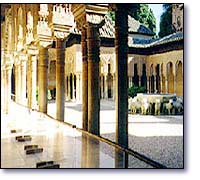
"The Court of the Lions" on the Alhambra Hill |
By Sergio Ortiz, Los Angeles Times Syndicate, 05/13/98
The treasured Alhambra and web of ancient streets give Granada, Spain its haunting lilt.
GRANADA, Spain -- ``The Guadalquivir skips from orange trees to
olive groves, but the rivers in Granada flow from snow to wheat.''
He's a Gypsy and looks like Willie Nelson, if Willie had jet-black
hair and coal eyes, and he's reciting the poem in that melodious
Spanish Gypsy measure that sounds more like Arabic than Castilian.
Three German girls -- students no doubt -- are all aflutter at hearing
the deep voice of the Gypsy sending the words of Federico Garcia Lorca
echoing off the walls of this city where the poet lived.
|
INFO:
Where to stay: Parador de San Francisco (The San Francisco), Alhambra 18009;
011-34-58-221-440. Reservations are difficult to get. From about $180/night.
For guides and events: Tourist Office of Spain, 8383 Wilshire Blvd.,
Suite 956, Beverly Hills, Calif. 90211; (213) 658-7188.
Click here for more information. |
|
This is Garcia Lorca country. He was born in a village on the
outskirts, and 38 years later was stood against a wall outside the
city and shot during the Spanish Civil War, along with two
bullfighters and countless others considered subversives by Francisco
Franco's Loyalists.
The Gypsy Willie Nelson is reciting Garcia Lorca's ``The Ballad of
the Three Rivers.'' The girls are throwing pesetas in a box at his
feet.
It's so typically Spanish, I think, as I continue my walk to
Albaicin Hill. It's a long, steep haul. In a few minutes I'm
hopelessly lost in the perplexing streets in the oldest quarter of
this ancient city. The confusing web of narrow, cobblestoned streets
seem eerily deserted, and the whitewashed houses are all locked.
Flowers spill from window boxes, and once in a while the faint smells
of rosemary and myrtle drift from small, well-tended gardens. The
whole place looks like an heirloom. And it is.
The Spanish crown has proclaimed Granada a national treasure in a
nation full of treasures, as it should be. It has been designated a
UNESCO World Heritage Site. The city is in the heart of Andalusia, the
region where everything you think of as Spanish began: bullfights,
flamenco music -- even the guitar was given its modern shape here.
Sure, Granada lacks the sangfroid of Seville, the bustle of Madrid and
the cosmopolitan panache of Barcelona, but it is the very soul of
Spain.
Walking up Albaicin Hill from San Juan de los Reyes, the wide
avenue where I stopped to watch the Gypsy minstrel banter with German
students, I found it difficult to pinpoint why I like Granada so much.
It's not pretty. As a matter of fact, the city sprawls amid the Vega
de Granada, a dusty plain. It's old, very old, and there isn't much to
do, except walk around the remnants of a culture that disappeared
centuries ago. But there's something about it that makes you suspect
that there might be a grain of truth behind the Spanish proverb that
holds that there's no greater sadness than to be blind in Granada.
Take the Albaicin, for example. It's a quaint district where
antiquity stuns the senses. For centuries it's been home to a long
list of cultures and races. Romans, Visigoths, Jews, Arabs, all lived
here at one time or another. The Romans set up a fortress on the
crest. Then came the Jews, followed by the Moors, who stayed six
centuries before being driven out by Ferdinand and Isabella, whose
bodies are down there in the cathedral, near where the poetry-loving
Gypsy hangs out.
Traces of those cultures are everywhere. At the top of the hill,
you'll know the climb has been worth it when you come up on a
panoramic view of the magnificent Alhambra from the plaza in front of
San Nicolas, a rather drab church built on top of a mosque by the
Spanish when they captured Granada from the Moors in 1492; the mosque,
in turn, was built on the rubble of the Roman fortress. When the
weather is right, florists and jugglers, singers and clowns, snack
vendors and balloon makers, sometimes even knife sharpeners, set up
shop here and turn the place into a maddening street fair. It's better
to go alone during a midweek afternoon to catch the sights without
being hassled.
The climb up and down the Albaicin is sure to make you feel
ravenous, and the hungrier you get the more tantalizing the smells
gliding out of quaint bodegas at the bottom of the hill will be. The
menus will confuse those who learned their Spanish on this side of the
Atlantic.
Although I speak Spanish, the nuances of the mother tongue as
spoken in Spain can be a problem. When in Spain, I am linguistically
challenged. I feel like a rapper in Windsor Castle. The first time I
visited the Albaicin, I stopped at a bodega and ordered something
called the ``tortilla Sacromonte.'' I knew that in Spain tortilla
means omelet and that Sacromonte is the Gypsy quarter a few blocks
away. So far so good. It was a delicious feast, Granada's regional
dish, I was told, and I enjoyed it tremendously. When I asked for the
recipe, I found out that the omelet's main ingredients are shredded
bull's testicles and beef brain mixed with vegetables.
This time, in a different bodega, I ordered gazpacho and didn't ask
what was in it. Some things are better left unknown.
Unless you have a keen interest in history, a two- or three-day
stay in Granada should give you an ample taste of this fascinating
town where Catholicism cloaks a Muslim heritage and exposes the
simultaneously sad and happy countenance of the Andalusians. If you
know the city only through the writings of Washington Irving, you will
be disappointed. Much has changed, and that change is nowhere as
evident as in the Alhambra, the delicate Moorish palace that looks
like it was made from fine lace and filigree.
I went there early one morning hoping to catch the ambience of
centuries ago, before tourist buses began bringing mobs to trample in
the rose gardens and throw coins in the fountains. I met a woman named
Rebeca waiting at the employee's entrance. She's an archeological
architect employed by the Spanish government and, although I tried to
cajole her into letting me in, she wouldn't hear of it. She gave me a
good account of the Alhambra, though. According to her, there are
almost 150 masons, sculptors, plumbers, gardeners and architects
working full-time to sustain the palace's glory. She said that is a
difficult job complicated by the fact that it was built from the worse
possible materials. It's all clay bricks and wood, she said, and
wasn't built to last.
``When you go inside, after the gates open,'' she said, softly
reminding me that there was no way she was going to let me in to
explore alone, ``you'll see water all over the place. Close your eyes
anywhere in the palace and you'll hear the ripple of fountains. The
Moors made it like this because, being desert nomads, water was an
extremely precious commodity. The Koran describes Eden as a garden
flowing with streams, so they patterned the Alhambra after that
passage in Scripture.''
An hour or so later, when I walked in with a group after paying a
$2 fee, I saw why the Alhambra has captured the imagination of poets
and writers. It's a jewel, a golden palace that underlines the fact
that while Europe was wallowing in the ignorance of the Dark Ages, the
Arabs in Spain were making serious advances in architecture,
philosophy, medicine and literature.
There are no statues of humans anywhere in the Alhambra, since
Muslims believe that the reproduction of human form should be left to
Allah. What you see instead is an intricate masterpiece where the
words ``There is no God but Allah'' and ``Allah alone is the victor''
are written in the angular Arabic Kufic script on most of the palace
walls.
According to history, Abu Abdullah was the last Muslim lord of the
Alhambra. After Ferdinand and Isabella took the Moorish capital of
Cordoba, they marched to lay siege to Granada, Islam's last
significant stronghold in Spain. Abdullah knew that his defending
force was small and that he had no military trump cards left to play.
It was only a matter of time before the superior Christian forces
overwhelmed the city. He passed the siege eating pomegranates (from
which the city gets its name) and listening to poems, while his mother
harangued him.
The battle for Granada lasted three months. During his flight out
of town with his many wives and pushy mother, he stopped for a last
melancholic look at the Alhambra from a hill still called ``El Suspiro
del Moro'' -- the Moor's Sigh. At the foot of Alhambra Hill, near the
Plaza Nueva on the left side of the Darro, one of the rivers that
Garcia Lorca wrote about, stands the cathedral. The victorious
Christians built it on the site of the Great Mosque of Granada, but
nothing of its Moorish roots remains. What one sees today is a
Renaissance-style church full of Flemish art, a few Botticellis,
Isabella's jewels (no, she didn't hock them to fund Columbus' trip
across the sea), Ferdinand's sword -- and the bodies of Isabella,
Ferdinand, their insane daughter Joanna the Mad, and her ambitious
husband, Philip the Handsome.
A lot of Granada's history took place just a few blocks from the
cathedral. I walked over a bridge to the Plaza Bibarrambla for coffee,
passing the prissy Corral de Carbon, a restored merchant's inn with a
marvelous courtyard, and sat in a cafe to watch the street scene in
the same plaza where centuries ago Moorish knights jousted.
A few blocks north is the Alcaceria, the legendary Arab silk
market. In ancient times it stretched all the way to Alhambra Hill and
was described as a rabbit's warren madhouse where merchants from all
over Islam came to trade. The real Alcaceria burned down years ago,
and the market has never been the same. Go at night, and stay for a
drink in one of the outdoor cafes to watch the lanterns give the
courtyards an eerie glow.
Another interesting place of which only the myth remains is
Sacromonte, where Granada's cave-dwelling Gypsies have lived for
centuries. Years ago, the place must have been something, the cradle
of flamenco, where tantalizing, seductive beauties danced inside smoky
caves to the strain of guitars and castanets. Although the caves are
inhabited and some are still used for flamenco shows, the whole place
is a waste of time. Visitors are warned by taxi drivers and concierges
to stay away. That advice, at least for me, is a come-on I can't
resist. I went. I saw. And everyone was right, for a change. It's a
rip-off, the quintessential tourist trap, and I've seen better
flamenco in Cordoba.
On the other side of the coin is La Cartuja, the
Carthusian Monastery about a mile north of Sacromonte. It is a
whimsical baroque church that, from 1506, took 300 years to build.
Back in the city, you'll find that Granada offers a wide range of
good hotels. If you're lucky, or have made reservations about a year
in advance, you might get a room in one of Spain's most elegant
paradores. These are government-run tourist accommodations in ancient
castles or monasteries, usually full of treasures and antiques.
But no matter where you stay in Granada, you'll find it a great
ancient city, full of life that will haunt you for years after -- if
cities can come back to haunt you the way dead people are said to do.
INFORMATION:
Where to stay: Parador de San Francisco, Alhambra 18009; tel.
011-34-58-221-440. The San Francisco is Spain's most famous and
historic parador. Reservations are extremely difficult to get. From
about $180 per night.
Alhambra Palace, Pena Partida 2, 18009; tel. 011-34-58-221-468.
Built at the turn of the century, this hotel sits on the slopes of
Alhambra Hill facing the Sierra Nevada. The lobby looks like a mosque,
all Arab pillars and arches, while the rooms are decorated with
Moorish tiles. From about $160 per night.
Hotel Inglaterra, Cetti Meriem 4; tel. 011-34-58-221-559. Guests in
this hotel that looks like something out of 1920s Spain have included
Ernest Hemingway and Humphrey Bogart. It's located in the heart of the
city, and the main building is a restored mansion built centuries ago.
Great lobby, comfortable rooms, from about $125 per night.
Where to eat: El Molino, Camino de las Fuentes, Paraje de las
Islas, 18650 Durcal; tel. 58-780-247. About 15 miles from downtown
Granada, it's housed in an old mill with museum and wine-tasting room.
Entrees $18-$45.
For more information: Tourist Office of Spain, 8383 Wilshire Blvd.,
Suite 956, Beverly Hills, Calif. 90211; tel. (213) 658-7188; fax (213)
658-1061.
(Sergio Ortiz is a Malibu, Calif.-based, free-lance writer.)
© 1998, Sergio Ortiz. Distributed by Los Angeles Times Syndicate.